NEW! Production-ready GenAI in 2026 - The architecture blueprint enterprise leaders need to scale GenAI Get Started.




NEW! Production-ready GenAI in 2026 - The architecture blueprint enterprise leaders need to scale GenAI Get Started.
NEW! Production-ready GenAI in 2026 - The architecture blueprint enterprise leaders need to scale GenAI Get Started.



What Is Agentic Search
SearchAI’s Agentic Search
Turning Intent Into Action
SearchAI’s Agentic Search
Turning Intent Into Action
Agentic search goes beyond retrieval. It understands intent, connects knowledge, and guides action.
Here’s why the traditional enterprise search is quietly failing your enterprise, and how to fix it.
September 16, 2025
From matching keywords to results, to enabling conversational search to fetch summarized answers. Human expectations of search keep evolving.
From matching keywords to results, to enabling conversational search to fetch summarized answers. Human expectations of search keep evolving.
And now, the needle has moved again.
And now, the needle has moved again.
Users now expect search to understand what they mean, find the right information across systems, and help them take the next step.
Users now expect search to understand what they mean, find the right information across systems, and help them take the next step.
Whether someone is looking for an HR policy, troubleshooting a customer issue, choosing the right product, or completing an internal workflow, the expectation is the same: don’t just show information - make it useful.
Whether someone is looking for an HR policy, troubleshooting a customer issue, choosing the right product, or completing an internal workflow, the expectation is the same: don’t just show information - make it useful.
This gap — between retrieval and understanding — is precisely what agentic search is designed to close.
This gap — between retrieval and understanding — is precisely what agentic search is designed to close.
What Agentic Search Actually Means
What Agentic Search Actually Means
Agentic search understands the person behind the query. It does not just match keywords or generate a quick summary. It reads what the user is trying to do, connects the right content and data across systems, and shapes the answer around context, behavior, role, and journey.
Agentic search understands the person behind the query. It does not just match keywords or generate a quick summary. It reads what the user is trying to do, connects the right content and data across systems, and shapes the answer around context, behavior, role, and journey.
With Agentic Search, the path moves from question to connected context to the next best action.
With Agentic Search, the path moves from question to connected context to the next best action.
Search Evolution: Traditional vs Semantic vs Agentic
Search Evolution: Traditional vs Semantic vs Agentic
A side-by-side look at traditional search, semantic search, and agentic search.
Capability
Capability
Query handling
Retrieval
Context
Personalization
Output
Workflow role
Maintenance
Governance
Traditional
Search
Traditional
Search
Keyword matching
Keyword index
None
Rule-based
Ranked results list
Separate from work
Synonym tables and merchandising rules
Permissions on content
Semantic Search
Semantic Search
Natural language understanding
Vector-based similarity
Partial
Basic behavioral signals
Generated summary
Limited integration
Ongoing model tuning
Partial controls
Agentic
Search
Agentic
Search
Deep intent - all signals extracted together
Hybrid retrieval across keyword, vector and knowledge graphs
Connected relationships across alternatives, bundles, policies, workflows, and use cases
Journey-aware and role-aware personalization across anonymous and identified sessions
Answer with cited source and guided next ste
Integrated into workflows - search becomes part of how work gets done
Knowledge Graph updates automatically from data
Permission-aware at query time, auditable, with private LLM option
Core Function
AI Agent
Focuses on autonomous execution of complex, multi-step tasks.
AI Assistant
Primarily provides information and completes simple tasks.
Autonomy
AI Agent
High; can operate independently with minimal human intervention.
AI Assistant
Limited; requires frequent human input and guidance.
Decision-Making
AI Agent
Employs advanced reasoning and decision-making capabilities.
AI Assistant
Often relies on predefined rules or scripts.
Learning & Adaptation
AI Agent
Continuously learns and adapts to new information and situations.
AI Assistant
May have some learning capabilities, but often limited.
Tool Integration
AI Agent
Seamlessly integrates with a wide range of tools and APIs to perform actions.
AI Assistant
May have limited integration with external tools and systems
Workflow Execution
AI Agent
Can orchestrate and execute complex, multi-step workflows.
AI Assistant
Typically handles single-step tasks or simple workflows.
Examples
AI Agent
Automated customer service agents, complex process automation systems, intelligent research assistants.
AI Assistant
Chatbots, virtual assistants, basic task automation tools.
How SearchAI Is Built for This Shift
How SearchAI Is Built for This Shift
SearchAI is the platform SearchBlox built to make agentic search real in production — not as a pilot, but as operational infrastructure
SearchAI is the platform SearchBlox built to make agentic search real in production — not as a pilot, but as operational infrastructure

Deep Intent Understanding
Deep Intent Understanding
Understanding what the user is really asking for
Understanding what the user is really asking for
Most search systems still read a query too literally. They look at the words, match them to content, and return what appears relevant
SearchAI takes a different approach. It looks at the meaning inside the request.
A user may type a long, natural-language query with several signals in it: product type, budget, size, location, role, urgency, policy context, or use case. SearchAI treats that as one complete request, not a handful of separate keywords.
That is important because people rarely search neatly anymore. They describe what they need in the way they would explain it to another person. Deep Intent Understanding helps SearchAI understand the full request before results are ranked, so the experience starts closer to what the user meant.
Most search systems still read a query too literally. They look at the words, match them to content, and return what appears relevant
SearchAI takes a different approach. It looks at the meaning inside the request.
A user may type a long, natural-language query with several signals in it: product type, budget, size, location, role, urgency, policy context, or use case. SearchAI treats that as one complete request, not a handful of separate keywords.
That is important because people rarely search neatly anymore. They describe what they need in the way they would explain it to another person. Deep Intent Understanding helps SearchAI understand the full request before results are ranked, so the experience starts closer to what the user meant.
Automatic Content Enrichment
Automatic Content Enrichment
Giving content the signals search needs
Giving content the signals search needs
Understanding the query is only part of the work. The content itself also needs richer context.
SearchAI’s automatic content enrichment helps make existing content easier to understand, retrieve, and use. Titles, summaries, tags, metadata, and related signals can be generated automatically, so documents, product data, PDFs, slides, and knowledge assets become more findable.
This matters because most enterprise content was not created for search. It was written for people, stored across systems, and often left without clean metadata. Automatic content enrichment helps close that gap by giving SearchAI more signals to work with.
So when a user asks a question, the system is not only reading the query better, but also reading the content better.
Understanding the query is only part of the work. The content itself also needs richer context.
SearchAI’s automatic content enrichment helps make existing content easier to understand, retrieve, and use. Titles, summaries, tags, metadata, and related signals can be generated automatically, so documents, product data, PDFs, slides, and knowledge assets become more findable.
This matters because most enterprise content was not created for search. It was written for people, stored across systems, and often left without clean metadata. Automatic content enrichment helps close that gap by giving SearchAI more signals to work with.
So when a user asks a question, the system is not only reading the query better, but also reading the content better.
Hybrid Search + RAG + Knowledge Graphs
Hybrid Search + RAG + Knowledge Graphs
Retrieving trusted answers from connected knowledge
Retrieving trusted answers from connected knowledge
Agentic search depends on the quality of retrieval. If the wrong context is retrieved, even a well-written AI answer becomes unreliable.
SearchAI combines Hybrid Search, RAG, and Knowledge Graphs to solve that problem at the retrieval layer.
Hybrid Search brings together keyword precision and semantic understanding. RAG grounds generated answers in actual enterprise content instead of model memory.
Knowledge Graphs add the relationship layer, helping SearchAI understand how content connects across systems, topics, workflows, products, policies, and user intent.
This means SearchAI does not simply fetch a document and summarize it. It retrieves across connected sources, understands the relationships around the content, and grounds the response in information users can trust.
Agentic search depends on the quality of retrieval. If the wrong context is retrieved, even a well-written AI answer becomes unreliable.
SearchAI combines Hybrid Search, RAG, and Knowledge Graphs to solve that problem at the retrieval layer.
Hybrid Search brings together keyword precision and semantic understanding. RAG grounds generated answers in actual enterprise content instead of model memory.
Knowledge Graphs add the relationship layer, helping SearchAI understand how content connects across systems, topics, workflows, products, policies, and user intent.
This means SearchAI does not simply fetch a document and summarize it. It retrieves across connected sources, understands the relationships around the content, and grounds the response in information users can trust.
Hyper Personalization
Hyper Personalization
Making every search feel closer to the user’s intent
Making every search feel closer to the user’s intent
Personalization should not feel like a separate feature sitting on top of search. It should feel like the system understood the situation better.
In SearchAI, personalization is part of how search responds.
The same query can mean different things depending on who is asking, what they have done before, where they are in the journey, and what they are allowed to access. SearchAI uses behaviour, context, role, journey signals, and permissions to make results and recommendations more relevant.
For shoppers, that means discovery can adapt as they view, compare, save, and return.
For employees, results can reflect role, team, recent work, and access boundaries.
That is how search becomes easier to use: not by asking users to refine more, but by understanding more from the start.
Personalization should not feel like a separate feature sitting on top of search. It should feel like the system understood the situation better.
In SearchAI, personalization is part of how search responds.
The same query can mean different things depending on who is asking, what they have done before, where they are in the journey, and what they are allowed to access. SearchAI uses behaviour, context, role, journey signals, and permissions to make results and recommendations more relevant.
For shoppers, that means discovery can adapt as they view, compare, save, and return.
For employees, results can reflect role, team, recent work, and access boundaries.
That is how search becomes easier to use: not by asking users to refine more, but by understanding more from the start.
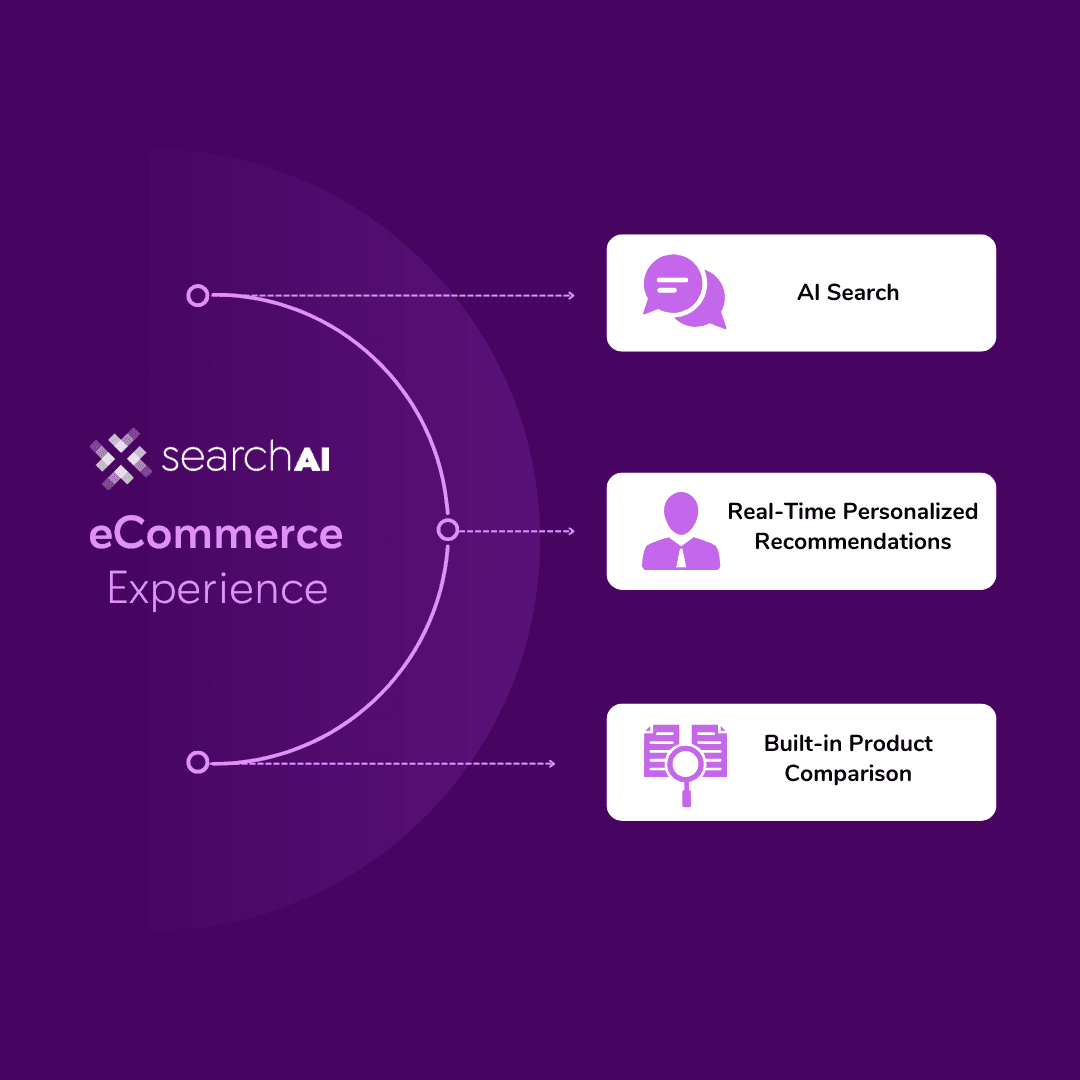
Why eCommerce needs SearchAI.
Why eCommerce needs SearchAI.
Why eCommerce needs SearchAI.

Earn customer loyalty without invading privacy
Earn customer loyalty without invading privacy
SearchAI emphasizes privacy-first experiences—contextual, in-session intelligence rather than third-party cookie trails.
SearchAI emphasizes privacy-first experiences—contextual, in-session intelligence rather than third-party cookie trails.
Built for speed, not replatforms
Built for speed, not replatforms
Drop in Recommend, SmartSuggest, and Assist alongside your current e-commerce store to speed up performance—no rip-and-replace required.
Drop in Recommend, SmartSuggest, and Assist alongside your current e-commerce store to speed up performance—no rip-and-replace required.
Works from day one — no cold start
Works from day one — no cold start
Personalizes for anonymous or authenticated shoppers using live session signals and your catalog, so value shows up fast.
Personalizes for anonymous or authenticated shoppers using live session signals and your catalog, so value shows up fast.
Why It Matters for Your Business
Why It Matters for Your Business
Why It Matters for Your Business
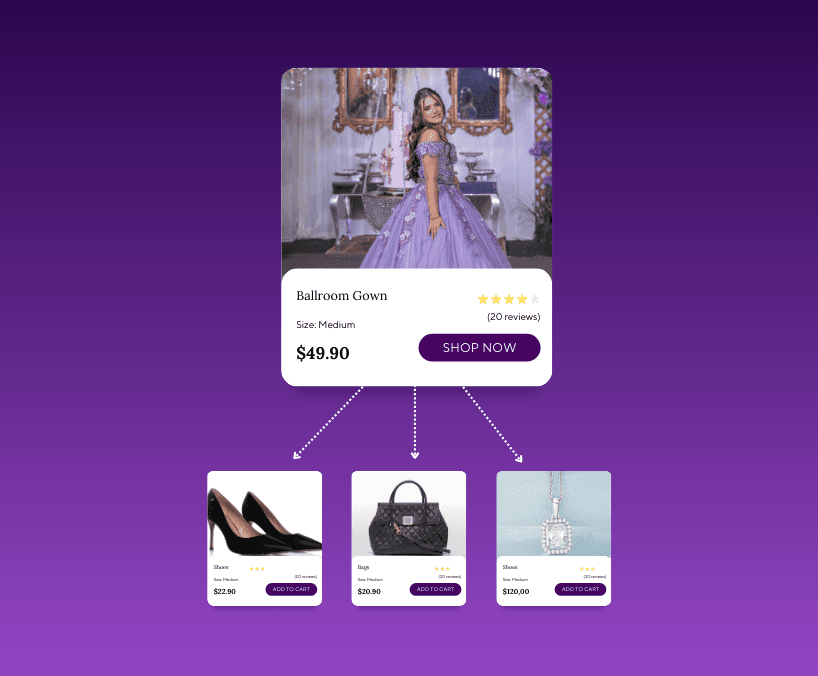
Personalization only works when it’s timely, contextual, and private. SearchAI transforms search into real-time, 1:1 guidance using live session signals and your catalog—not surveillance. We suggest next-best items and add on-page comparisons so shoppers decide in the moment. That’s how eCommerce becomes both effortless and measurable at scale.
Personalization only works when it’s timely, contextual, and private. SearchAI transforms search into real-time, 1:1 guidance using live session signals and your catalog—not surveillance. We suggest next-best items and add on-page comparisons so shoppers decide in the moment. That’s how eCommerce becomes both effortless and measurable at scale.
Timo Selvaraj, Chief Product Officer, SearchBlox
From Search to Sale—Now
From Search to Sale—Now
From Search to Sale—Now
See on-page comparisons and contextual recommendations reduce bounce. Book a quick session to see how it impact with your catalog.
See on-page comparisons and contextual recommendations reduce bounce. Book a quick session to see how it impact with your catalog.
See on-page comparisons and contextual recommendations reduce bounce. Book a quick session to see how it impact with your catalog.




Enhance your users’ digital experience.
Security & Compliance
Certifications



SearchAI is SOC 2 attested, HIPAA aligned, ISO/IEC 27001:2022 certified and ISO/IEC 42001:2023 certified.
We build AI-driven software to help organizations leverage their unstructured, and structured data for operational success.
4870 Sadler Road, Suite 300, Glen Allen, VA 23060 sales@searchblox.com | (866) 933-3626





Still learning about AI? See our comprehensive Enterprise Search, Knowledge Graph 101, RAG 101, ChatBot 101, and AI Agents 101 guides.
©2026 SearchBlox Software, Inc. All rights reserved.
Enhance your users’ digital experience.
Security & Compliance
Certifications
SearchAI is SOC 2 attested, HIPAA aligned, and ISO/IEC 27001:2022 certified.
We build AI-driven software to help organizations leverage their unstructured, and structured data for operational success.
4870 Sadler Road, Suite 300, Glen Allen, VA 23060 sales@searchblox.com | (866) 933-3626
Still learning about AI? See our comprehensive Enterprise Search, Knowledge Graph 101, RAG 101, ChatBot 101, and AI Agents 101 guides.
©2026 SearchBlox Software, Inc. All rights reserved.
Enhance your users’ digital experience.
Security & Compliance
Certifications
SearchAI is SOC 2 attested, HIPAA aligned, ISO/IEC 27001:2022 certified and ISO/IEC 42001:2023 certified.
We build AI-driven software to help organizations leverage their unstructured, and structured data for operational success.
4870 Sadler Road, Suite 300, Glen Allen, VA 23060 sales@searchblox.com | (866) 933-3626
Still learning about AI? See our comprehensive Enterprise Search, Knowledge Graph 101, RAG 101, ChatBot 101, and AI Agents 101 guides.
©2024 SearchBlox Software, Inc. All rights reserved.