NEW! Production-ready GenAI in 2026 - The architecture blueprint enterprise leaders need to scale GenAI Get Started.




NEW! Production-ready GenAI in 2026 - The architecture blueprint enterprise leaders need to scale GenAI Get Started.
NEW! Production-ready GenAI in 2026 - The architecture blueprint enterprise leaders need to scale GenAI Get Started.


Defining the Future of Knowledge Management:
Enterprise Search Trends for 2026
Defining the Future of Knowledge Management:
Enterprise Search Trends for 2026
Defining the Future of Knowledge Management
Enterprise Search Trends for 2026
December 26, 2025
Enterprise search is no longer just about finding documents. In 2026, it will power decisions, automation, and action.
Enterprise search is no longer just about finding documents. In 2026, it will power decisions, automation, and action.
The induction of AI-led systems in the digital world has led to many changes in online behavior. Enterprise search isn’t just getting smarter, it’s becoming strategic. Enterprise search is no longer just about finding documents; it is now central to how organizations learn, make decisions, and take action. As companies grapple with sprawling data landscapes and growing AI maturity, search is transforming from a lookup tool into a core layer of business intelligence and workflow execution.
The induction of AI-led systems in the digital world has led to many changes in online behavior. Enterprise search isn’t just getting smarter, it’s becoming strategic. Enterprise search is no longer just about finding documents; it is now central to how organizations learn, make decisions, and take action. As companies grapple with sprawling data landscapes and growing AI maturity, search is transforming from a lookup tool into a core layer of business intelligence and workflow execution.
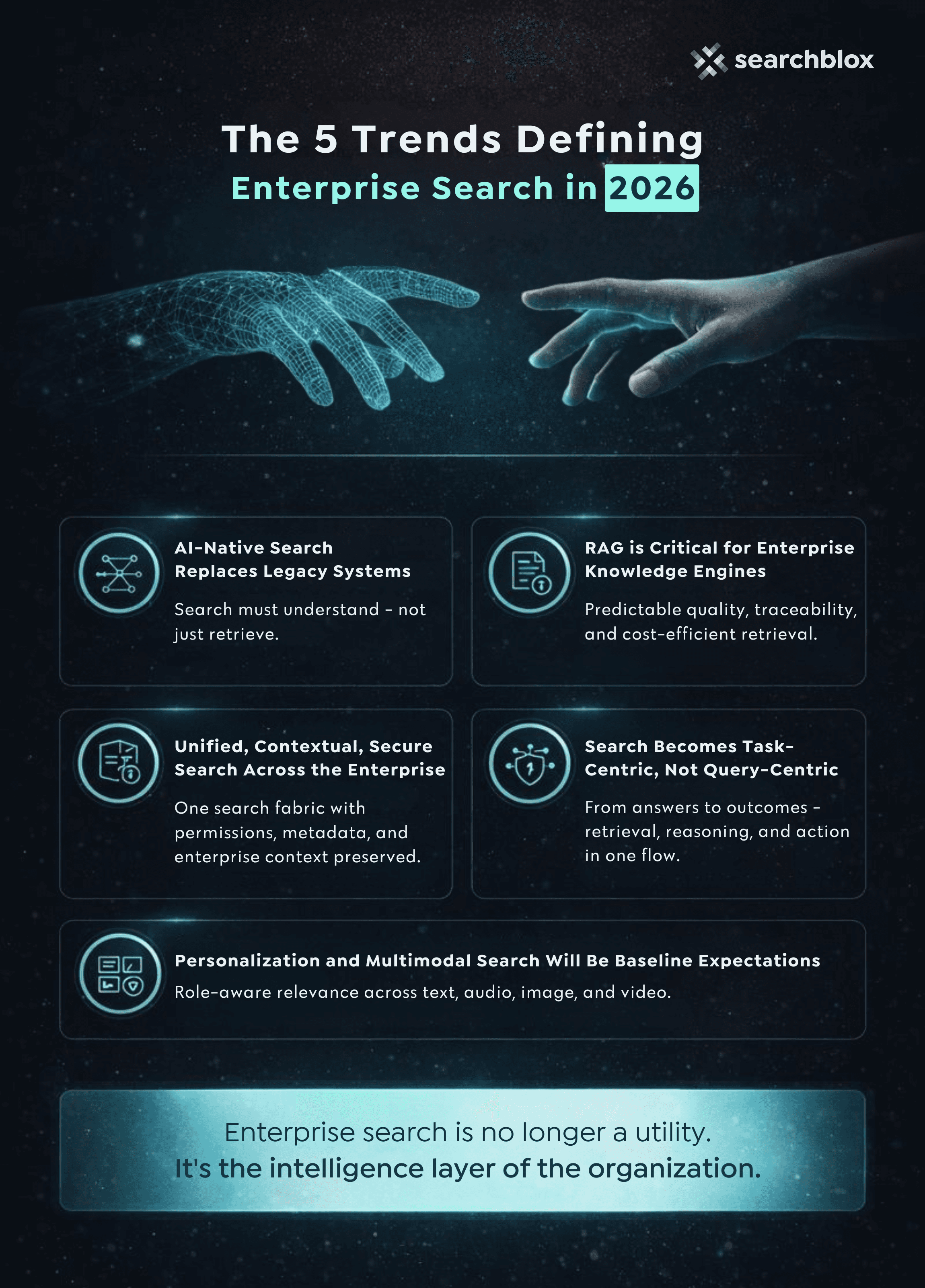
With 2024 being the year of AI introduction and 2025 marking the full-scale induction, how will this change enterprise search in 2026? Here are the five trends that will define enterprise search in 2026.
With 2024 being the year of AI introduction and 2025 marking the full-scale induction, how will this change enterprise search in 2026? Here are the five trends that will define enterprise search in 2026.
Explore the SearchAI GenAI Platform
Explore the SearchAI GenAI Platform
Explore the SearchAI GenAI Platform
AI-Native Search Replaces Legacy Systems
AI-Native Search Replaces Legacy Systems
AI-Native Search Replaces Legacy Systems
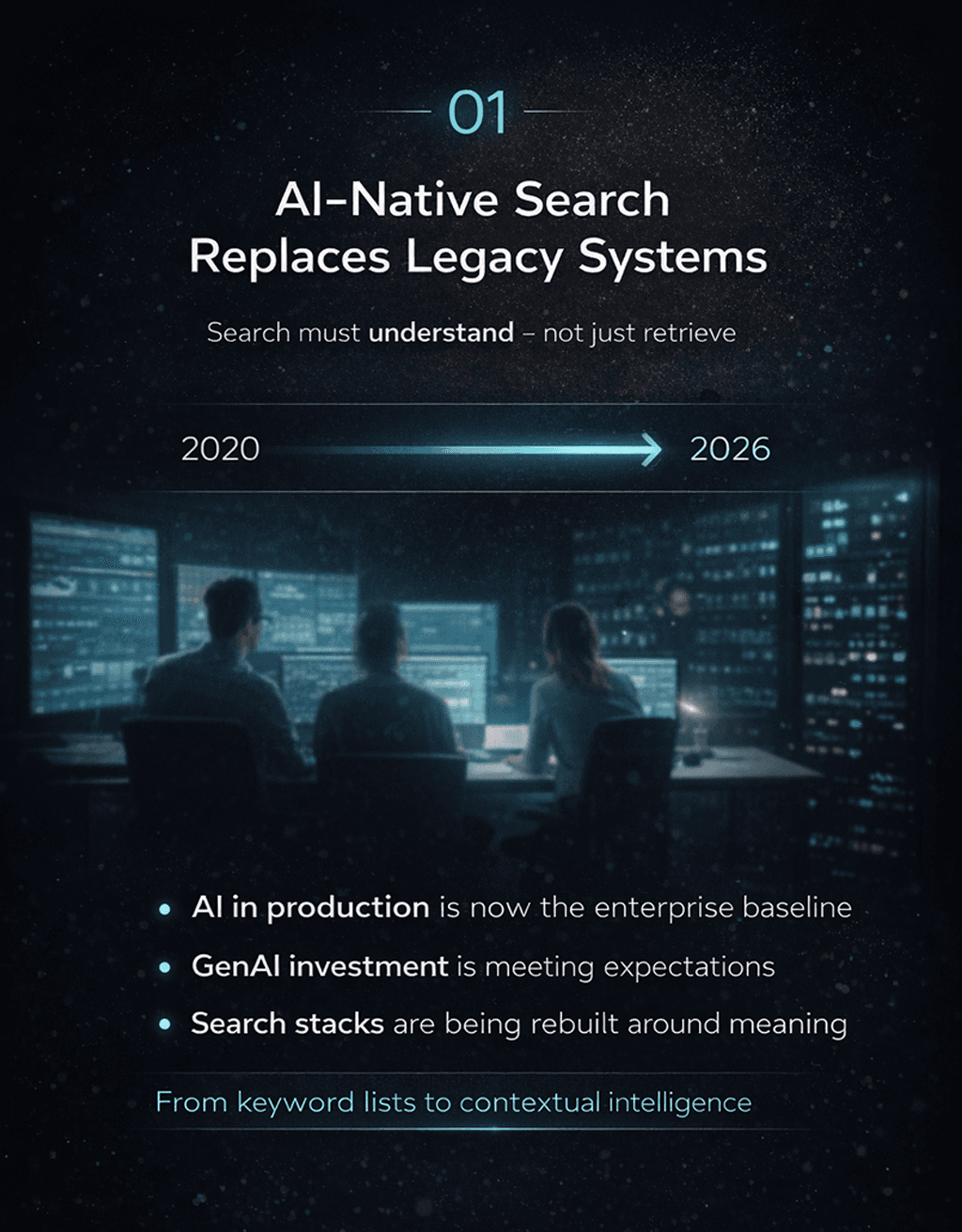
Enterprise AI adoption has jumped sharply.
87% of enterprises now have AI in production, up from roughly 31% in 2020.
Enterprise AI adoption has jumped sharply. 87% of enterprises now have AI in production, up from roughly 31% in 2020.
Enterprise AI adoption has jumped sharply.
87% of enterprises now have AI in production, up from roughly 31% in 2020.
This acceleration reflects real operational demand, not hype. In 2026, search platforms will no longer be basic systems that resemble legacy systems with AI capabilities added on the side. We predict that the architecture of enterprise search systems will change.
This acceleration reflects real operational demand, not hype. In 2026, search platforms will no longer be basic systems that resemble legacy systems with AI capabilities added on the side. We predict that the architecture of enterprise search systems will change.
With 74% companies seeing investments in generative AI and automation meet or exceed expectations, and 63% planning to increase their efforts and further strengthen these capabilities by 2026. Enterprise search needs to see drastic change. Rather than retrofitting large language models onto keyword indices, modern search stacks are built around NLP, context interpretation, and semantic reasoning from the ground up. The result isn’t a list of links, the result is insight that is actionable and relevant.
This isn’t just tech for tech’s sake, organizations need search that understands, not just finds.
With 74% companies seeing investments in generative AI and automation meet or exceed expectations, and 63% planning to increase their efforts and further strengthen these capabilities by 2026. Enterprise search needs to see drastic change. Rather than retrofitting large language models onto keyword indices, modern search stacks are built around NLP, context interpretation, and semantic reasoning from the ground up. The result isn’t a list of links, the result is insight that is actionable and relevant.
This isn’t just tech for tech’s sake, organizations need search that understands, not just finds.
RAG is Critical for Enterprise Knowledge Engines
RAG is Critical for Enterprise Knowledge Engines
RAG is Critical for Enterprise Knowledge Engines
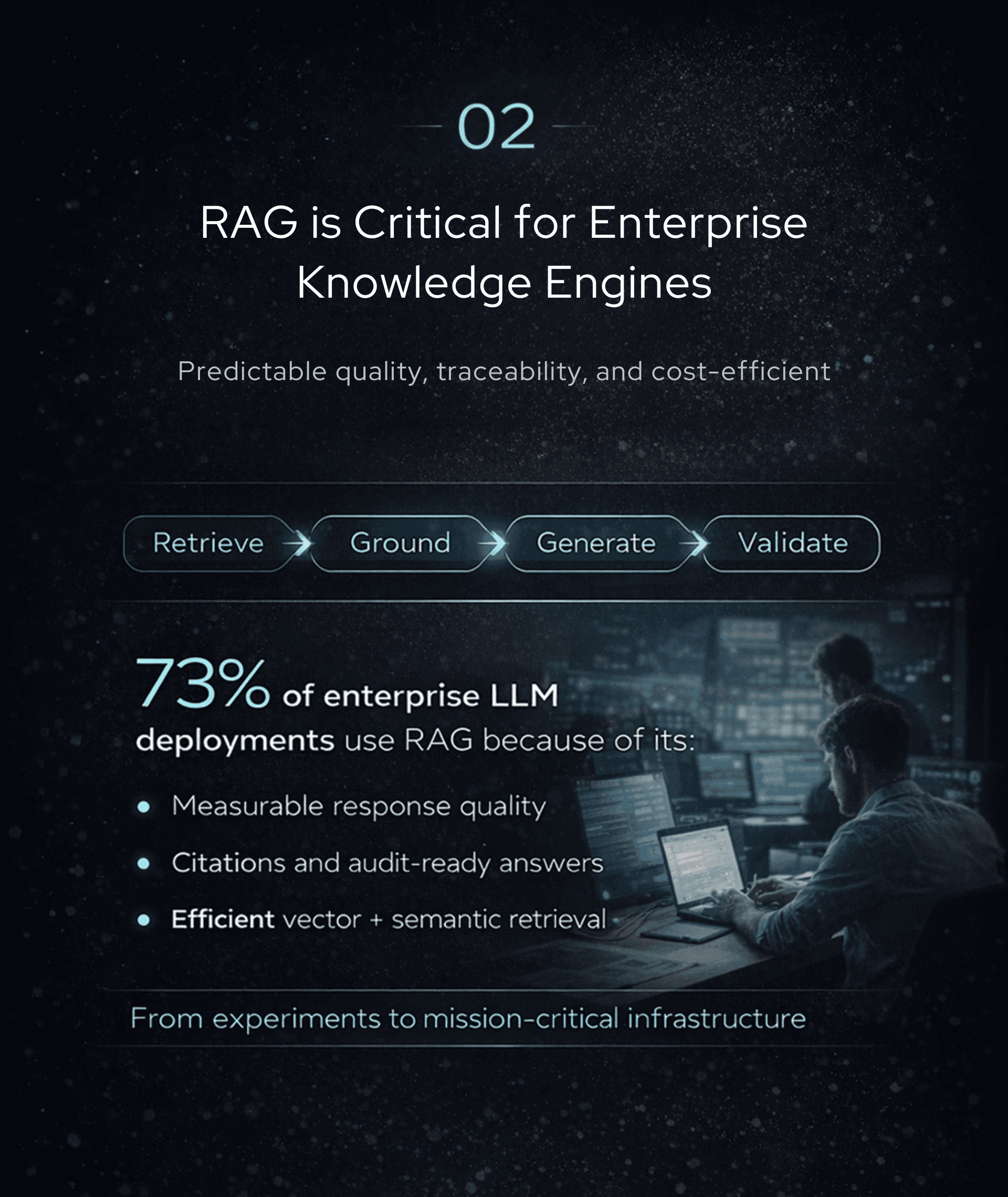
Retrieval-Augmented Generation (RAG) has gone from a buzzword to the dominant pattern in production AI systems. In fact, around 73 % of current enterprise LLM deployments use RAG architectures to root AI responses in real corporate knowledge.
Retrieval-Augmented Generation (RAG) has gone from a buzzword to the dominant pattern in production AI systems. In fact, around 73 % of current enterprise LLM deployments use RAG architectures to root AI responses in real corporate knowledge.
Retrieval-Augmented Generation (RAG) has gone from a buzzword to the dominant pattern in production AI systems. In fact, around 73 % of current enterprise LLM deployments use RAG architectures to root AI responses in real corporate knowledge.
2026 is when this methodology will really mature into being significantly important. Earlier RAG implementations often struggled with reliability, hallucinations, and integration gaps.
In 2026, enterprises will need to move towards systems that offer:
Predictable, measurable quality (not guesswork)
Traceability and audit paths for decision logic
Cost-efficient vector and semantic retrieval layers
This trend reflects the shift from AI “experiments” to mission-critical knowledge infrastructures.
2026 is when this methodology will really mature into being significantly important. Earlier RAG implementations often struggled with reliability, hallucinations, and integration gaps.
In 2026, enterprises will need to move towards systems that offer:
Predictable, measurable quality (not guesswork)
Traceability and audit paths for decision logic
Cost-efficient vector and semantic retrieval layers
This trend reflects the shift from AI “experiments” to mission-critical knowledge infrastructures.
2026 is when this methodology will really mature into being significantly important. Earlier RAG implementations often struggled with reliability, hallucinations, and integration gaps.
In 2026, enterprises will need to move towards systems that offer:
Predictable, measurable quality (not guesswork)
Traceability and audit paths for decision logic
Cost-efficient vector and semantic retrieval layers
This trend reflects the shift from AI “experiments” to mission-critical knowledge infrastructures.
Unified, Contextual, Secure Search Across Enterprise Silos
Unified, Contextual, Secure Search Across Enterprise Silos
Unified, Contextual, Secure Search Across Enterprise Silos
One constant has remained the same throughout the last few decades. Data continues to remain one of the most vital sources of insight and knowledge.
One constant has remained the same throughout the last few decades. Data continues to remain one of the most vital sources of insight and knowledge.
One constant has remained the same throughout the last few decades. Data continues to remain one of the most vital sources of insight and knowledge.
This acceleration reflects real operational demand, not hype. In 2026, search platforms will no longer be basic systems that resemble legacy systems with AI capabilities added on the side. We predict that the architecture of enterprise search systems will change.
This acceleration reflects real operational demand, not hype. In 2026, search platforms will no longer be basic systems that resemble legacy systems with AI capabilities added on the side. We predict that the architecture of enterprise search systems will change.
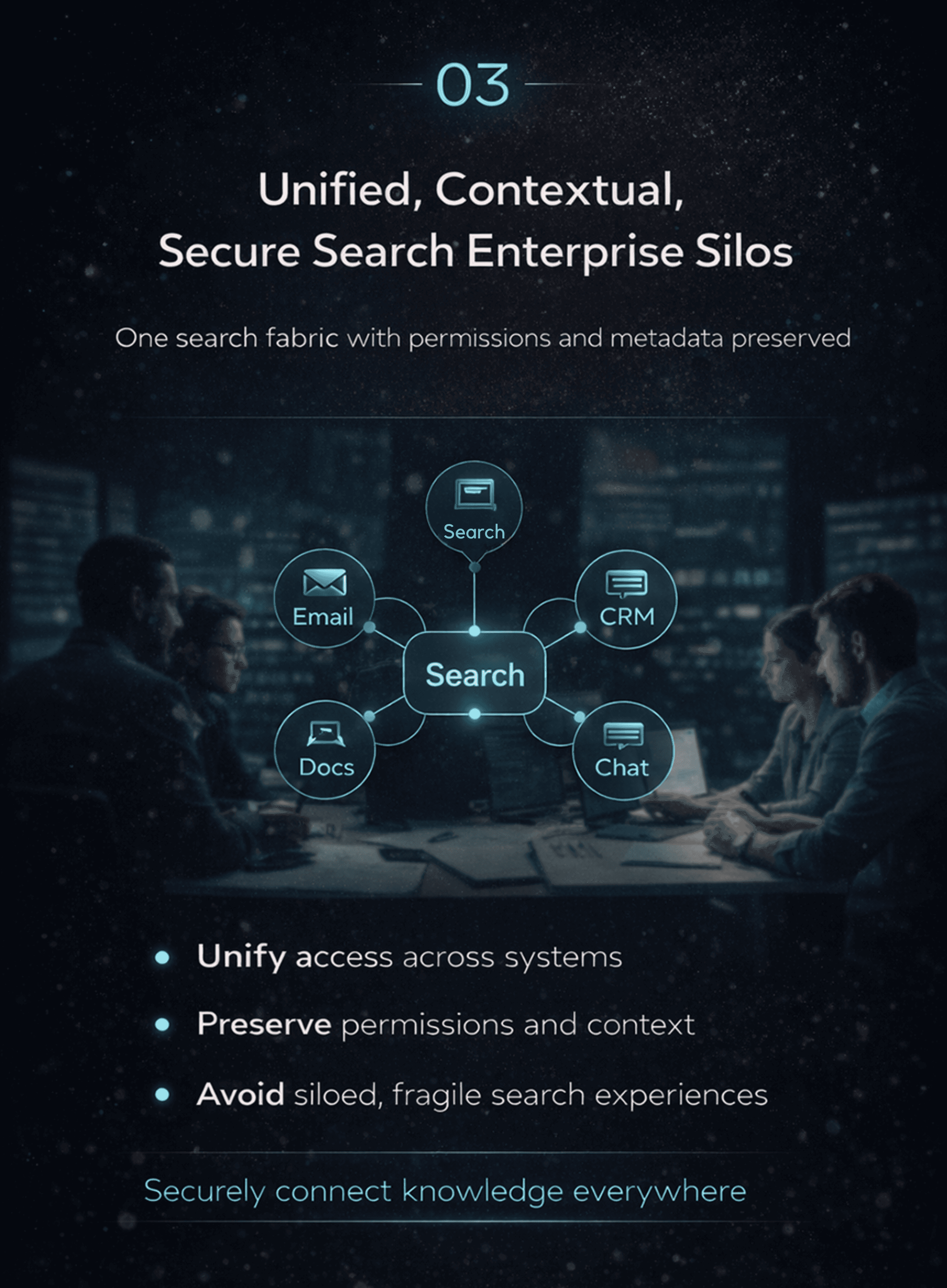
With over 67% Fortune 500 companies adopting AI search solutions, In 2026, forward-thinking organizations will:
Consolidate indexed content into a single search fabric
Preserve permissions, metadata, and enterprise context
Avoid fragile, siloed systems that treat data as isolated blobs
This isn’t about indexing every system, it’s about contextually understanding every system.
With over 67% Fortune 500 companies adopting AI search solutions, In 2026, forward-thinking organizations will:
Consolidate indexed content into a single search fabric
Preserve permissions, metadata, and enterprise context
Avoid fragile, siloed systems that treat data as isolated blobs
This isn’t about indexing every system, it’s about contextually understanding every system.
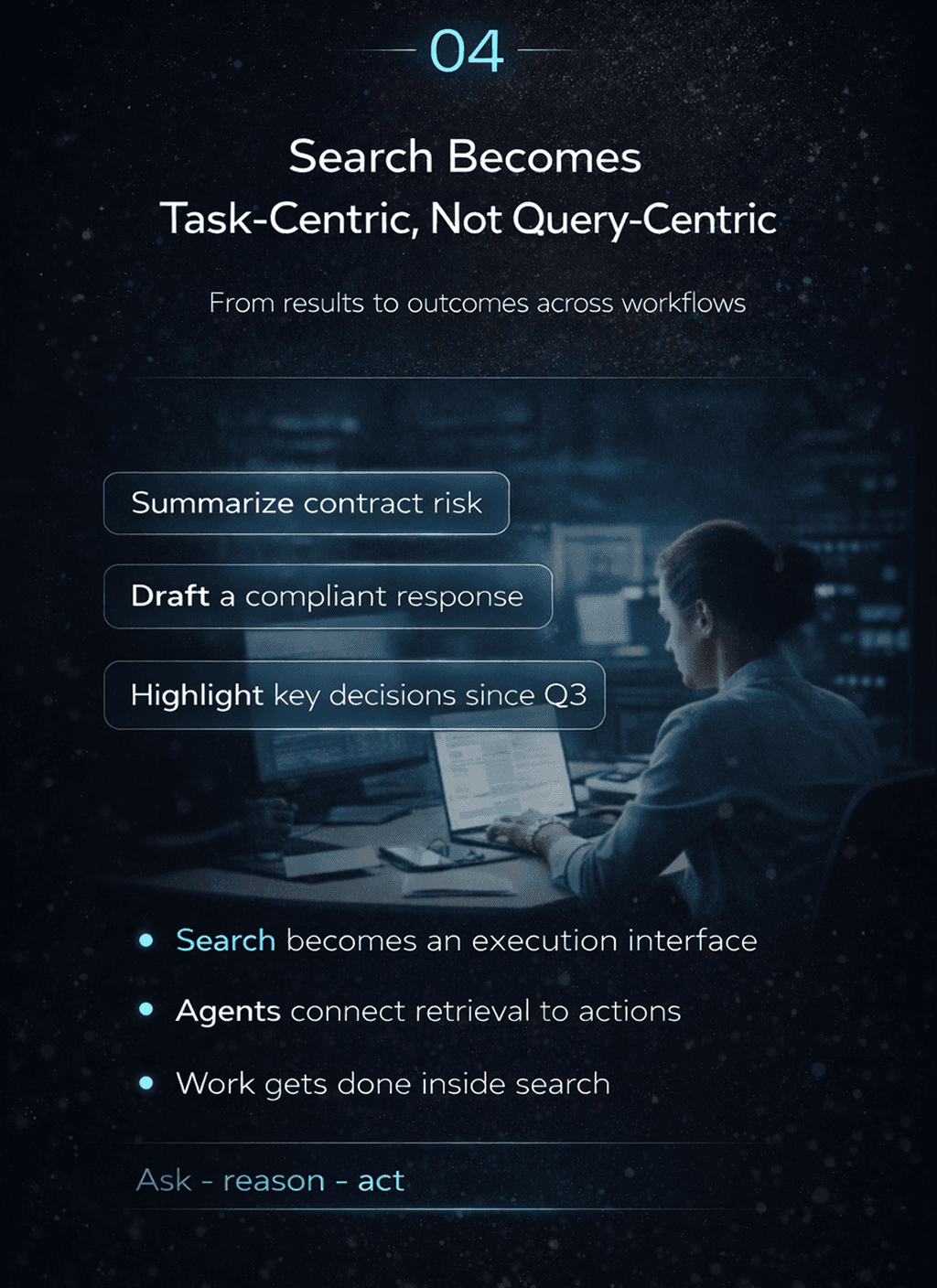
Search Becomes Task-Centric, Not Query-Centric
Search Becomes Task-Centric, Not Query-Centric
Search Becomes Task-Centric, Not Query-Centric
By 2026, search will be more than a “tell me what document this is.” Users will expect search to do work — to assist, to act, and to deliver outcomes. Analysts predict that roughly 35% of business intelligence queries will be powered by AI agents by 2026
By 2026, search will be more than a “tell me what document this is.” Users will expect search to do work — to assist, to act, and to deliver outcomes. Analysts predict that roughly 35% of business intelligence queries will be powered by AI agents by 2026
By 2026, search will be more than a “tell me what document this is.” Users will expect search to do work — to assist, to act, and to deliver outcomes. Analysts predict that roughly 35% of business intelligence queries will be powered by AI agents by 2026
This can be seen in the emerging trend of enterprises adopting agentic AI workflows that combine retrieval with automation, decision support, and SaaS actions.
In practice, this looks like users asking:
“Summarize risk exposures across these contracts.”
“Draft a customer response that complies with policy X.”
“Highlight all decisions affecting product Y since Q3.”
Search isn’t just finding answers. It’s becoming a contextual execution interface for complex work.
This can be seen in the emerging trend of enterprises adopting agentic AI workflows that combine retrieval with automation, decision support, and SaaS actions.
In practice, this looks like users asking:
“Summarize risk exposures across these contracts.”
“Draft a customer response that complies with policy X.”
“Highlight all decisions affecting product Y since Q3.”
Search isn’t just finding answers. It’s becoming a contextual execution interface for complex work.
Personalization and Multimodal Search Will Be Baseline Expectations
Personalization and Multimodal Search Will Be Baseline Expectations
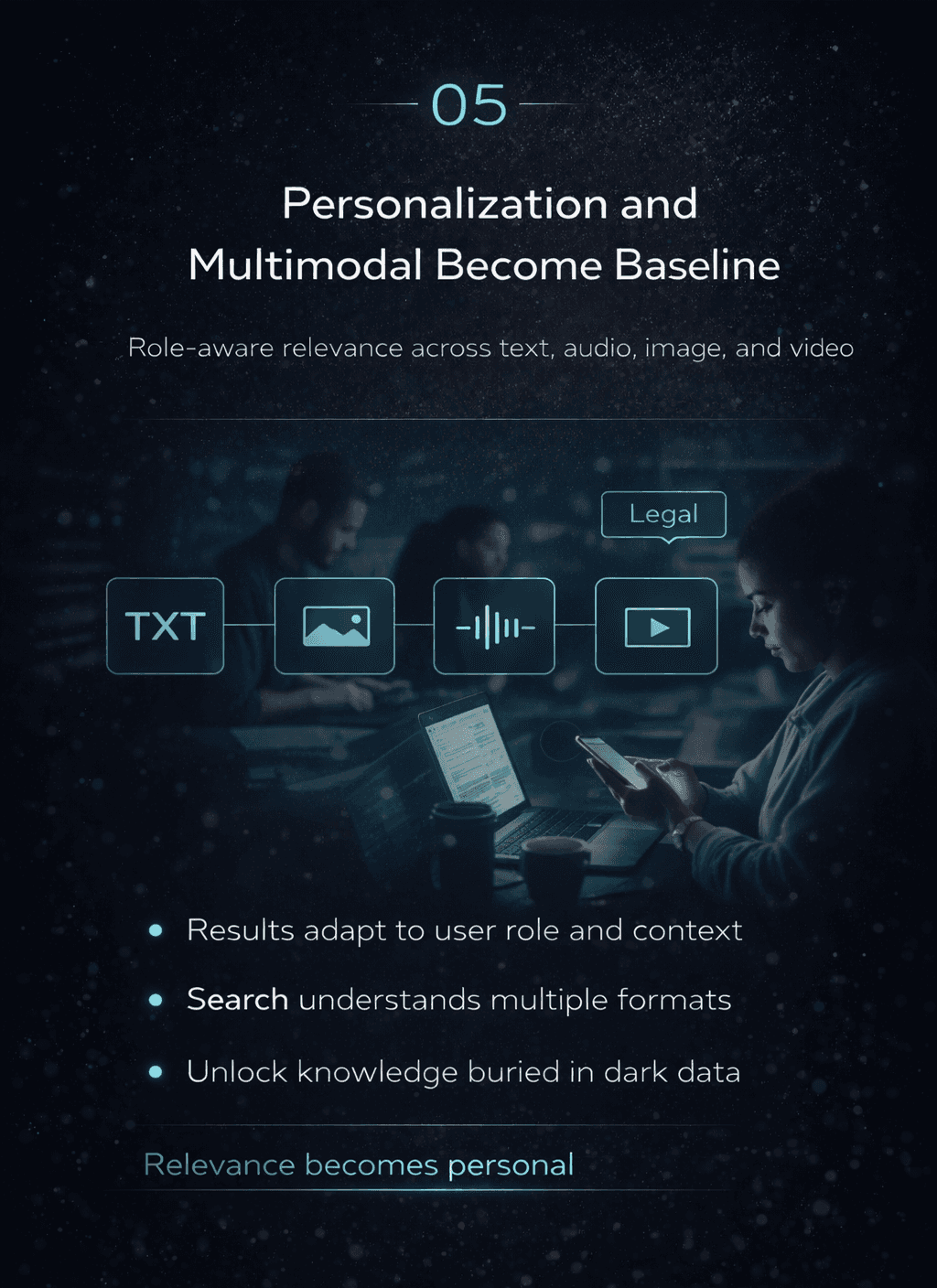
Static relevance i.e the same ranked list for everyone, can no longer scale in a world of diverse data types and roles.
Static relevance i.e the same ranked list for everyone, can no longer scale in a world of diverse data types and roles.
Static relevance i.e the same ranked list for everyone, can no longer scale in a world of diverse data types and roles.
The future of relevance is contextual and personalized search, informed by:
User roles and team affiliations
Historical behavior patterns
Content modality — text, audio, image, video
Industry data indicates that Personalization AI is projected as a $4.5B market by 2026. Additionally, multimodal search is a $2.84B segment by 2025, reflecting real demand to unlock “dark data.”
In 2026, merely handling text won’t be enough; search must understand the full spectrum of enterprise knowledge.
The future of relevance is contextual and personalized search, informed by:
User roles and team affiliations
Historical behavior patterns
Content modality — text, audio, image, video
Industry data indicates that Personalization AI is projected as a $4.5B market by 2026. Additionally, multimodal search is a $2.84B segment by 2025, reflecting real demand to unlock “dark data.”
In 2026, merely handling text won’t be enough; search must understand the full spectrum of enterprise knowledge.
What Does This All Mean
What Does This All Mean
What Does This All Mean
Taken together, these trends point to a simple but profound reality:
Enterprise search is no longer a utility; it’s the intelligence layer of the organization. It connects insight to action, unifies data across systems, and delivers personalized understanding at scale.
In 2026, the organizations that win won’t have better search tools; they will have better knowledge ecosystems driven by AI-native, secure, and operationally embedded search.
Taken together, these trends point to a simple but profound reality:
Enterprise search is no longer a utility; it’s the intelligence layer of the organization. It connects insight to action, unifies data across systems, and delivers personalized understanding at scale.
In 2026, the organizations that win won’t have better search tools; they will have better knowledge ecosystems driven by AI-native, secure, and operationally embedded search.
"Traditional enterprise search was built for static indexes and keyword matching.
Modern organizations operate in dynamic environments where knowledge is distributed, permissions matter, and decisions must happen in real time.
SearchAI represents a shift from finding information to operationalizing knowledge - combining retrieval, reasoning, and governance into a single intelligence layer."
"Traditional enterprise search was built for static indexes and keyword matching.
Modern organizations operate in dynamic environments where knowledge is distributed, permissions matter, and decisions must happen in real time.
SearchAI represents a shift from finding information to operationalizing knowledge - combining retrieval, reasoning, and governance into a single intelligence layer."
"Traditional enterprise search was built for static indexes and keyword matching.
Modern organizations operate in dynamic environments where knowledge is distributed, permissions matter, and decisions must happen in real time.
SearchAI represents a shift from finding information to operationalizing knowledge - combining retrieval, reasoning, and governance into a single intelligence layer."
Timo Selvaraj, Chief Product Officer, SearchBlox
See how SearchAI transforms enterprise search
See how SearchAI transforms enterprise search
See how SearchAI transforms enterprise search
Request a live demo and learn how SearchBlox SearchAI unified GenAI platform brings Hybrid Search, RAG, chat, agents, and analytics together — grounded in your enterprise data, governed by enterprise controls.
Request a live demo and learn how SearchBlox SearchAI unified GenAI platform brings Hybrid Search, RAG, chat, agents, and analytics together — grounded in your enterprise data, governed by enterprise controls.




Enhance your users’ digital experience.
Security & Compliance
Certifications



SearchAI is SOC 2 attested, HIPAA aligned, ISO/IEC 27001:2022 certified and ISO/IEC 42001:2023 certified.
We build AI-driven software to help organizations leverage their unstructured, and structured data for operational success.
4870 Sadler Road, Suite 300, Glen Allen, VA 23060 sales@searchblox.com | (866) 933-3626





Still learning about AI? See our comprehensive Enterprise Search, Knowledge Graph 101, RAG 101, ChatBot 101, and AI Agents 101 guides.
©2026 SearchBlox Software, Inc. All rights reserved.
Enhance your users’ digital experience.
Security & Compliance
Certifications
SearchAI is SOC 2 attested, HIPAA aligned, ISO/IEC 27001:2022 certified and ISO/IEC 42001:2023 certified.
We build AI-driven software to help organizations leverage their unstructured, and structured data for operational success.
4870 Sadler Road, Suite 300, Glen Allen, VA 23060 sales@searchblox.com | (866) 933-3626
Still learning about AI? See our comprehensive Enterprise Search, Knowledge Graph 101, RAG 101, ChatBot 101, and AI Agents 101 guides.
©2024 SearchBlox Software, Inc. All rights reserved.
Enhance your users’ digital experience.
Security & Compliance
Certifications
SearchAI is SOC 2 attested, HIPAA aligned, and ISO/IEC 27001:2022 certified.
We build AI-driven software to help organizations leverage their unstructured, and structured data for operational success.
4870 Sadler Road, Suite 300, Glen Allen, VA 23060 sales@searchblox.com | (866) 933-3626
Still learning about AI? See our comprehensive Enterprise Search, Knowledge Graph 101, RAG 101, ChatBot 101, and AI Agents 101 guides.
©2026 SearchBlox Software, Inc. All rights reserved.