NEW! SearchBlox is now an Adobe Platinum Technology Partner. I Get Started.




NEW! SearchBlox is now an Adobe Platinum Technology Partner. I Get Started.
NEW! SearchBlox is now an Adobe Platinum Technology Partner. I Get Started.


What Is Agentic Search
SearchAI’s Agentic Search
Turning Intent Into Action
SearchAI’s Agentic Search - Turning Intent Into Action
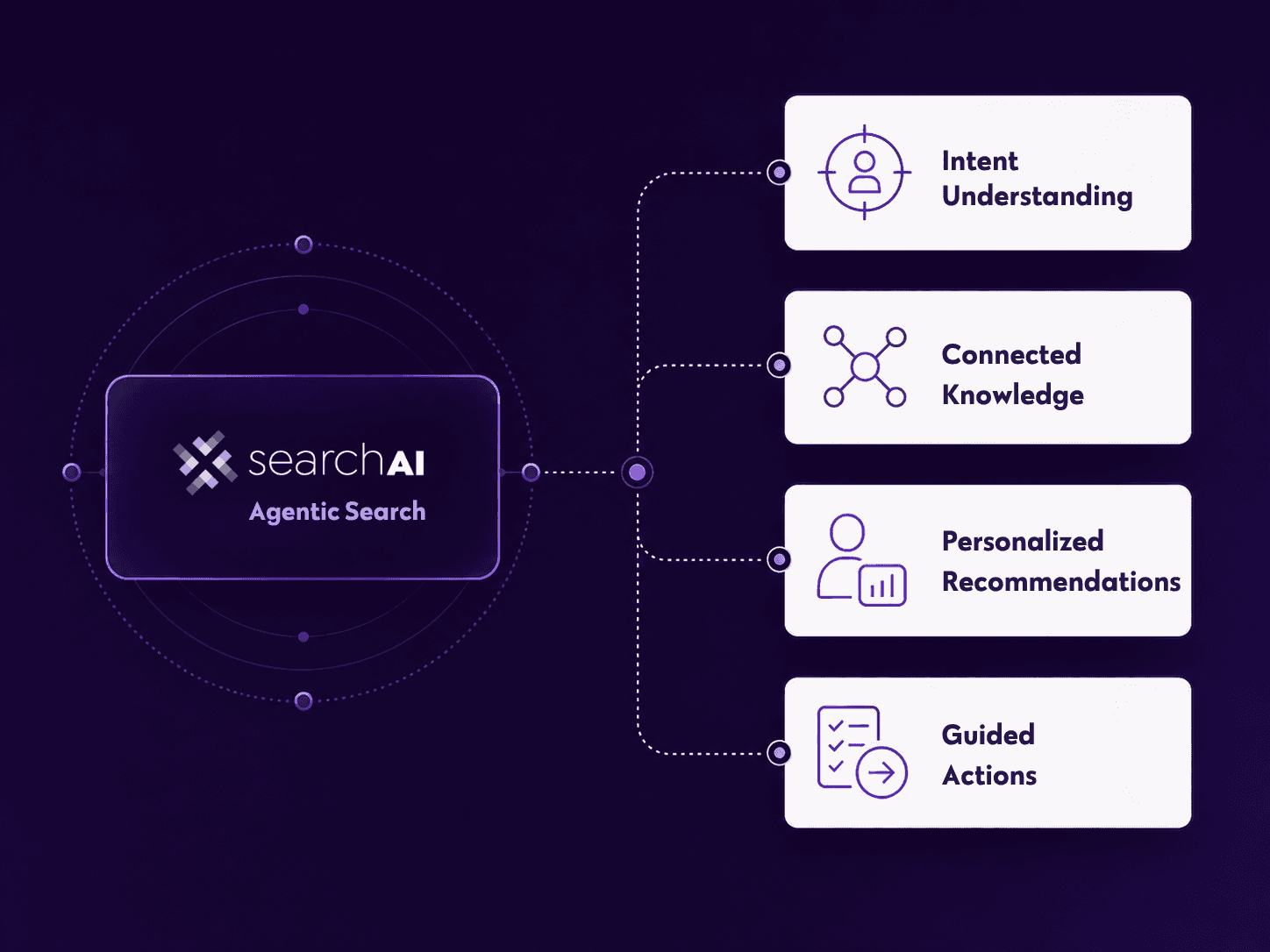
Agentic search goes beyond retrieval. It understands intent, connects knowledge, and guides action.
Here’s why the traditional enterprise search is quietly failing your enterprise, and how to fix it.
Agentic search goes beyond retrieval. It understands intent, connects knowledge, and guides action. Here’s why the traditional enterprise search is quietly failing your enterprise, and how to fix it.
Agentic search goes beyond retrieval. It understands intent, connects knowledge, and guides action. Here’s why the traditional enterprise search is quietly failing your enterprise, and how to fix it.
May 08, 2026
From matching keywords to results, to enabling conversational search to fetch summarized answers. Human expectations of search keep evolving.
From matching keywords to results, to enabling conversational search to fetch summarized answers. Human expectations of search keep evolving.
And now, the needle has moved again.
And now, the needle has moved again.
Users now expect search to understand what they mean, find the right information across systems, and help them take the next step.
Users now expect search to understand what they mean, find the right information across systems, and help them take the next step.
Whether someone is looking for an HR policy, troubleshooting a customer issue, choosing the right product, or completing an internal workflow, the expectation is the same: don’t just show information - make it useful.
Whether someone is looking for an HR policy, troubleshooting a customer issue, choosing the right product, or completing an internal workflow, the expectation is the same: don’t just show information - make it useful.
This gap — between retrieval and understanding — is precisely what agentic search is designed to close.
This gap — between retrieval and understanding — is precisely what agentic search is designed to close.
What Agentic Search Actually Means
What Agentic Search Actually Means
Agentic search understands the person behind the query. It does not just match keywords or generate a quick summary. It reads what the user is trying to do, connects the right content and data across systems, and shapes the answer around context, behavior, role, and journey.
Agentic search understands the person behind the query. It does not just match keywords or generate a quick summary. It reads what the user is trying to do, connects the right content and data across systems, and shapes the answer around context, behavior, role, and journey.
With Agentic Search, the path moves from question to connected context to the next best action.
With Agentic Search, the path moves from question to connected context to the next best action.
Search Evolution: Traditional vs Semantic vs Agentic
Search Evolution: Traditional vs Semantic vs Agentic
Search Evolution: Traditional vs Semantic vs Agentic
A side-by-side look at traditional search, semantic search, and agentic search.
Capability
Capability
Query handling
Query handling
Retrieval
Retrieval
Context
Context
Personalization
Personalization
Output
Output
Workflow role
Workflow role
Maintenance
Maintenance
Governance
Governance
Traditional
Search
Traditional
Search
Keyword matching
Keyword matching
Keyword index
Keyword index
None
None
Rule-based
Rule-based
Ranked results list
Ranked results list
Separate from work
Separate from work
Synonym tables and merchandising rules
Synonym tables and merchandising rules
Permissions on content
Permissions on content
Semantic Search
Semantic Search
Natural language understanding
Natural language understanding
Vector-based similarity
Vector-based similarity
Partial
Partial
Basic behavioral signals
Basic behavioral signals
Generated summary
Generated summary
Limited integration
Limited integration
Ongoing model tuning
Ongoing model tuning
Partial controls
Partial controls
Agentic
Search
Agentic
Search
Deep intent - all signals extracted together
Deep intent - all signals extracted together
Hybrid retrieval across keyword, vector and knowledge graphs
Hybrid retrieval across keyword, vector and knowledge graphs
Connected relationships across alternatives, bundles, policies, workflows, and use cases
Connected relationships across alternatives, bundles, policies, workflows, and use cases
Journey-aware and role-aware personalization across anonymous and identified sessions
Journey-aware and role-aware personalization across anonymous and identified sessions
Answer with cited source and guided next steps
Answer with cited source and guided next steps
Integrated into workflows - search becomes part of how work gets done
Integrated into workflows - search becomes part of how work gets done
Knowledge Graph updates automatically from data
Knowledge Graph updates automatically from data.
Permission-aware at query time, auditable, with private LLM option
Permission-aware at query time, auditable, with private LLM option
Query handling
Retrieval
Traditional Search
Keyword index
Semantic Search
Vector-based similarity
Agentic Search
Hybrid retrieval across keyword, vector and knowledge graphs
Context
Traditional Search
None
Semantic Search
Partial
Agentic Search
Connected relationships across alternatives, bundles, policies, workflows, and use cases
Traditional Search
Keyword matching
Semantic Search
Natural language understanding
Agentic Search
Deep intent - all signals extracted together
Personalization
Traditional Search
Rule-based
Semantic Search
Basic behavioral signals
Agentic Search
Journey-aware and role-aware personalization across anonymous and identified sessions
Output
Traditional Search
Ranked results list
Semantic Search
Generated summary
Agentic Search
Answer with cited source and guided next step
Workflow role
Traditional Search
Separate from work
Semantic Search
Limited integration
Agentic Search
Integrated into workflows - search becomes part of how work gets done
Maintenance
Traditional Search
Synonym tables and merchandising rules
Semantic Search
Ongoing model tuning
Agentic Search
Knowledge Graph updates automatically from data
Governance
Traditional Search
Permissions on content
Semantic Search
Partial controls
Agentic Search
Permission-aware at query time, auditable, with private LLM option
How SearchAI Is Built for This Shift
How SearchAI Is Built for This Shift
SearchAI is the platform SearchBlox built to make agentic search real in production — not as a pilot, but as operational infrastructure
SearchAI is the platform SearchBlox built to make agentic search real in production — not as a pilot, but as operational infrastructure
Deep Intent Understanding
Deep Intent Understanding
Deep Intent Understanding
Understanding what the user
is really asking for
Understanding what the user
is really asking for
Understanding what the user
is really asking for
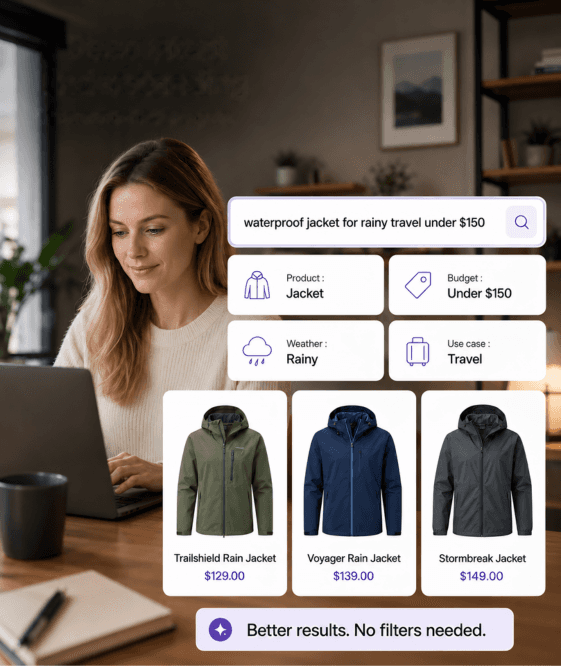
Most search systems still read a query too literally. They look at the words, match them to content, and return what appears relevant
SearchAI takes a different approach. It looks at the meaning inside the request.
A user may type a long, natural-language query with several signals in it: product type, budget, size, location, role, urgency, policy context, or use case. SearchAI treats that as one complete request, not a handful of separate keywords.
That is important because people rarely search neatly anymore. They describe what they need in the way they would explain it to another person. Deep Intent Understanding helps SearchAI understand the full request before results are ranked, so the experience starts closer to what the user meant.
Most search systems still read a query too literally. They look at the words, match them to content, and return what appears relevant
SearchAI takes a different approach. It looks at the meaning inside the request.
A user may type a long, natural-language query with several signals in it: product type, budget, size, location, role, urgency, policy context, or use case. SearchAI treats that as one complete request, not a handful of separate keywords.
That is important because people rarely search neatly anymore. They describe what they need in the way they would explain it to another person. Deep Intent Understanding helps SearchAI understand the full request before results are ranked, so the experience starts closer to what the user meant.
Most search systems still read a query too literally. They look at the words, match them to content, and return what appears relevant
SearchAI takes a different approach. It looks at the meaning inside the request.
A user may type a long, natural-language query with several signals in it: product type, budget, size, location, role, urgency, policy context, or use case. SearchAI treats that as one complete request, not a handful of separate keywords.
That is important because people rarely search neatly anymore. They describe what they need in the way they would explain it to another person. Deep Intent Understanding helps SearchAI understand the full request before results are ranked, so the experience starts closer to what the user meant.
Automatic Context Enrichment
Automatic Context Enrichment
Automatic Context Enrichment
Making content easier to find
Making content easier to find
Making content easier to find
Good search depends on good context.
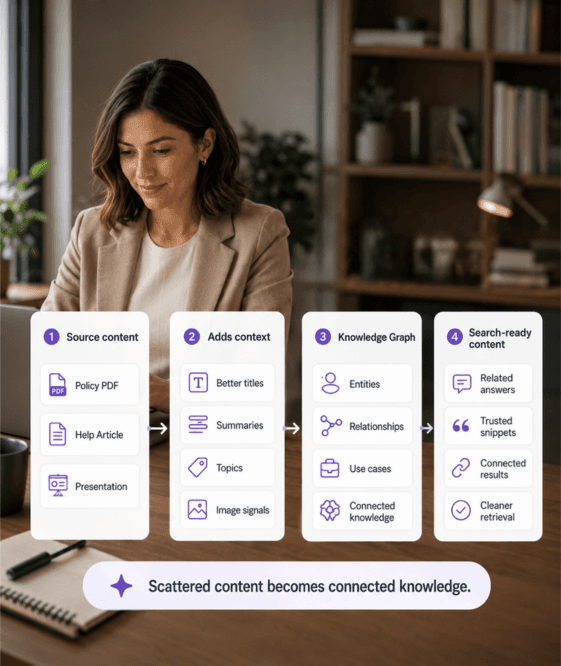
A document may have the right answer, but search can miss it if the title is vague, the summary is missing, or the important details are buried inside a PDF, slide, or image.
SearchAI helps fix this before users search. It enriches content with useful signals like titles, summaries, tags, image context, entities, and relationships.
Those signals help build the Knowledge Graph, so related documents, products, topics, and use cases are connected instead of sitting as separate pieces of content.
The result is simple: users find better answers because SearchAI has more context to work with.
Good search depends on good context.
A document may have the right answer, but search can miss it if the title is vague, the summary is missing, or the important details are buried inside a PDF, slide, or image.
SearchAI helps fix this before users search. It enriches content with useful signals like titles, summaries, tags, image context, entities, and relationships.
Those signals help build the Knowledge Graph, so related documents, products, topics, and use cases are connected instead of sitting as separate pieces of content.
The result is simple: users find better answers because SearchAI has more context to work with.
Good search depends on good context.
A document may have the right answer, but search can miss it if the title is vague, the summary is missing, or the important details are buried inside a PDF, slide, or image.
SearchAI helps fix this before users search. It enriches content with useful signals like titles, summaries, tags, image context, entities, and relationships.
Those signals help build the Knowledge Graph, so related documents, products, topics, and use cases are connected instead of sitting as separate pieces of content.
The result is simple: users find better answers because SearchAI has more context to work with.
Hybrid Search + RAG + Knowledge Graphs
Hybrid Search + RAG + Knowledge Graphs
Hybrid Search + RAG + Knowledge Graphs
Retrieving trusted answers from connected knowledge
Retrieving trusted answers from connected knowledge
Retrieving trusted answers from connected knowledge
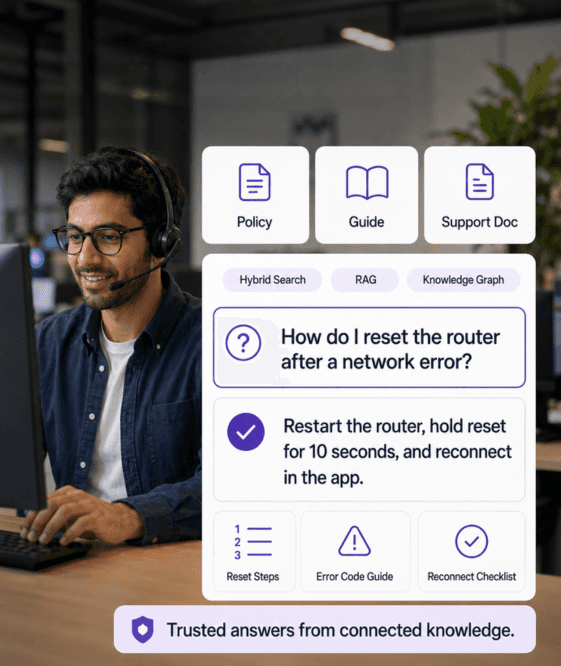
Agentic search depends on the quality of retrieval. If the wrong context is retrieved, even a well-written AI answer becomes unreliable.
SearchAI combines Hybrid Search, RAG, and Knowledge Graphs to solve that problem at the retrieval layer.
Hybrid Search brings together keyword precision and semantic understanding. RAG grounds generated answers in actual enterprise content instead of model memory.
Knowledge Graphs add the relationship layer, helping SearchAI understand how content connects across systems, topics, workflows, products, policies, and user intent.
This means SearchAI does not simply fetch a document and summarize it. It retrieves across connected sources, understands the relationships around the content, and grounds the response in information users can trust.
Agentic search depends on the quality of retrieval. If the wrong context is retrieved, even a well-written AI answer becomes unreliable.
SearchAI combines Hybrid Search, RAG, and Knowledge Graphs to solve that problem at the retrieval layer.
Hybrid Search brings together keyword precision and semantic understanding. RAG grounds generated answers in actual enterprise content instead of model memory.
Knowledge Graphs add the relationship layer, helping SearchAI understand how content connects across systems, topics, workflows, products, policies, and user intent.
This means SearchAI does not simply fetch a document and summarize it. It retrieves across connected sources, understands the relationships around the content, and grounds the response in information users can trust.
Agentic search depends on the quality of retrieval. If the wrong context is retrieved, even a well-written AI answer becomes unreliable.
SearchAI combines Hybrid Search, RAG, and Knowledge Graphs to solve that problem at the retrieval layer.
Hybrid Search brings together keyword precision and semantic understanding. RAG grounds generated answers in actual enterprise content instead of model memory.
Knowledge Graphs add the relationship layer, helping SearchAI understand how content connects across systems, topics, workflows, products, policies, and user intent.
This means SearchAI does not simply fetch a document and summarize it. It retrieves across connected sources, understands the relationships around the content, and grounds the response in information users can trust.
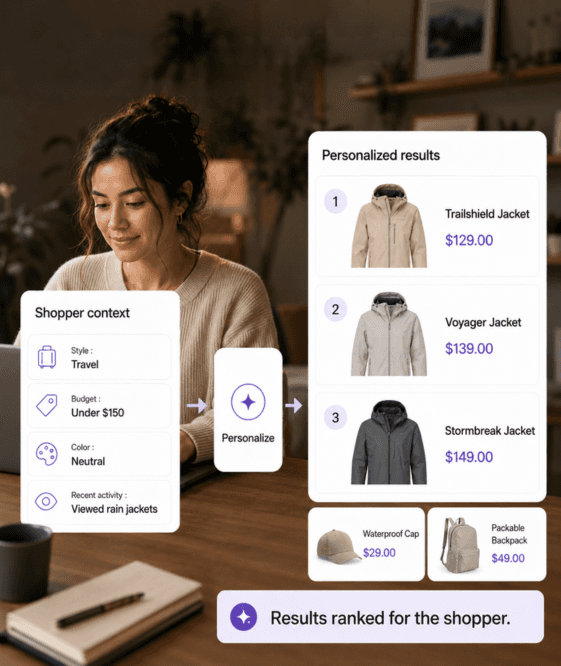
Hyper Personalization
Hyper Personalization
Hyper Personalization
Making every result feel more relevant
Making every result feel more relevant
Making every result feel more relevant
Personalization should not feel like a separate feature sitting on top of search. It should feel like the system understood the situation better.
In SearchAI, personalization is part of how search responds.
The same query can mean different things depending on who is asking, what they have done before, where they are in the journey, and what they are allowed to access. SearchAI uses behaviour, context, role, journey signals, and permissions to make results and recommendations more relevant.
For shoppers, that means discovery can adapt as they view, compare, save, and return.
For employees, results can reflect role, team, recent work, and access boundaries.
That is how search becomes easier to use: not by asking users to refine more, but by understanding more from the start.
Personalization should not feel like a separate feature sitting on top of search. It should feel like the system understood the situation better.
In SearchAI, personalization is part of how search responds.
The same query can mean different things depending on who is asking, what they have done before, where they are in the journey, and what they are allowed to access. SearchAI uses behaviour, context, role, journey signals, and permissions to make results and recommendations more relevant.
For shoppers, that means discovery can adapt as they view, compare, save, and return.
For employees, results can reflect role, team, recent work, and access boundaries.
That is how search becomes easier to use: not by asking users to refine more, but by understanding more from the start.
Personalization should not feel like a separate feature sitting on top of search. It should feel like the system understood the situation better.
In SearchAI, personalization is part of how search responds.
The same query can mean different things depending on who is asking, what they have done before, where they are in the journey, and what they are allowed to access. SearchAI uses behaviour, context, role, journey signals, and permissions to make results and recommendations more relevant.
For shoppers, that means discovery can adapt as they view, compare, save, and return.
For employees, results can reflect role, team, recent work, and access boundaries.
That is how search becomes easier to use: not by asking users to refine more, but by understanding more from the start.
REAL IMPACT. REAL OUTCOMES.
REAL IMPACT. REAL OUTCOMES.
Where Agentic Search Changes Real Work
Where Agentic Search Changes Real Work
eCommerce Product Discovery
What Users Experience Today
Shoppers type complex queries, get irrelevant results, apply multiple filters, try again, then abandon.
Long-tail searches return keyword noise.
What Agentic Search with SearchAI Delivers
Deep Intent Capture extracts all buying signals simultaneously. Knowledge Graph surfaces alternatives, bundles, and compatible products. Visual Search handles queries that start with an image. First-page results reflect actual intent — no filter required.
Enterprise Knowledge Search
What Users Experience Today
Employees search across 5+ systems, open 12 documents to find the answer, discover outdated content, ask a colleague instead. Knowledge is technically present but practically inaccessible
What Agentic Search with SearchAI Delivers
SearchAI connects 300+ sources via pre-built connectors. RAG returns a cited, grounded answer. The Knowledge Graph maps how documents, policies, and workflows relate. Permissions are enforced at query time. One search step, one trusted answer.
Customer Self-Service and Support
What Users Experience Today
Customers search a static knowledge base, find articles that don't match their situation, escalate to a human agent, wait. Support agents search for resolution steps, find conflicting versions, escalate further.
What Agentic Search with SearchAI Delivers
SearchAI Agents and ChatBot return guided responses grounded in retrieved content, with connected resolution steps and escalation paths surfaced automatically. Ticket volume drops. Handle time falls. Answers are consistent.
Workplace Workflows
What Users Experience Today
Search sits outside the systems where work happens. Employees toggle between applications to find context. Decisions get made without the right information because finding it takes longer than the deadline allows.
What Agentic Search with SearchAI Delivers
SearchAI integrates into the workflow - surfacing the right document, the right policy, the right next action at the point where the decision needs to be made. Search becomes part of how work moves forward, not a separate step before it can begin.
eCommerce Product Discovery
What Users Experience Today
Shoppers type complex queries, get irrelevant results, apply multiple filters, try again, then abandon.
Long-tail searches return keyword noise.
What Agentic Search with SearchAI Delivers
Deep Intent Capture extracts all buying signals simultaneously. Knowledge Graph surfaces alternatives, bundles, and compatible products. Visual Search handles queries that start with an image. First-page results reflect actual intent — no filter required.
Enterprise Knowledge Search
What Users Experience Today
Employees search across 5+ systems, open 12 documents to find the answer, discover outdated content, ask a colleague instead. Knowledge is technically present but practically inaccessible
What Agentic Search with SearchAI Delivers
SearchAI connects 300+ sources via pre-built connectors. RAG returns a cited, grounded answer. The Knowledge Graph maps how documents, policies, and workflows relate. Permissions are enforced at query time. One search step, one trusted answer.
Customer Self-Service and Support
What Users Experience Today
Customers search a static knowledge base, find articles that don't match their situation, escalate to a human agent, wait. Support agents search for resolution steps, find conflicting versions, escalate further.
What Agentic Search with SearchAI Delivers
SearchAI Agents and ChatBot return guided responses grounded in retrieved content, with connected resolution steps and escalation paths surfaced automatically. Ticket volume drops. Handle time falls. Answers are consistent.
Workplace Workflows
What Users Experience Today
Search sits outside the systems where work happens. Employees toggle between applications to find context. Decisions get made without the right information because finding it takes longer than the deadline allows.
What Agentic Search with SearchAI Delivers
SearchAI integrates into the workflow - surfacing the right document, the right policy, the right next action at the point where the decision needs to be made. Search becomes part of how work moves forward, not a separate step before it can begin.
eCommerce Product Discovery
What Users Experience Today
Shoppers type complex queries, get irrelevant results, apply multiple filters, try again, then abandon.
Long-tail searches return keyword noise.
What Agentic Search with SearchAI Delivers
Deep Intent Capture extracts all buying signals simultaneously. Knowledge Graph surfaces alternatives, bundles, and compatible products. Visual Search handles queries that start with an image. First-page results reflect actual intent — no filter required.
Enterprise Knowledge Search
What Users Experience Today
Employees search across 5+ systems, open 12 documents to find the answer, discover outdated content, ask a colleague instead. Knowledge is technically present but practically inaccessible
What Agentic Search with SearchAI Delivers
SearchAI connects 300+ sources via pre-built connectors. RAG returns a cited, grounded answer. The Knowledge Graph maps how documents, policies, and workflows relate. Permissions are enforced at query time. One search step, one trusted answer.
Customer Self-Service and Support
What Users Experience Today
Customers search a static knowledge base, find articles that don't match their situation, escalate to a human agent, wait. Support agents search for resolution steps, find conflicting versions, escalate further.
What Agentic Search with SearchAI Delivers
SearchAI Agents and ChatBot return guided responses grounded in retrieved content, with connected resolution steps and escalation paths surfaced automatically. Ticket volume drops. Handle time falls. Answers are consistent.
Workplace Workflows
What Users Experience Today
Search sits outside the systems where work happens. Employees toggle between applications to find context. Decisions get made without the right information because finding it takes longer than the deadline allows.
What Agentic Search with SearchAI Delivers
SearchAI integrates into the workflow - surfacing the right document, the right policy, the right next action at the point where the decision needs to be made. Search becomes part of how work moves forward, not a separate step before it can begin.
eCommerce Product Discovery
What Users Experience Today
Shoppers type complex queries, get irrelevant results, apply multiple filters, try again, then abandon.
Long-tail searches return keyword noise.
What Agentic Search with SearchAI Delivers
Deep Intent Capture extracts all buying signals simultaneously. Knowledge Graph surfaces alternatives, bundles, and compatible products. Visual Search handles queries that start with an image. First-page results reflect actual intent — no filter required.
Enterprise Knowledge Search
What Users Experience Today
Employees search across 5+ systems, open 12 documents to find the answer, discover outdated content, ask a colleague instead. Knowledge is technically present but practically inaccessible
What Agentic Search with SearchAI Delivers
SearchAI connects 300+ sources via pre-built connectors. RAG returns a cited, grounded answer. The Knowledge Graph maps how documents, policies, and workflows relate. Permissions are enforced at query time. One search step, one trusted answer.
Customer Self-Service and Support
What Users Experience Today
Customers search a static knowledge base, find articles that don't match their situation, escalate to a human agent, wait. Support agents search for resolution steps, find conflicting versions, escalate further.
What Agentic Search with SearchAI Delivers
SearchAI Agents and ChatBot return guided responses grounded in retrieved content, with connected resolution steps and escalation paths surfaced automatically. Ticket volume drops. Handle time falls. Answers are consistent.
Workplace Workflows
What Users Experience Today
Search sits outside the systems where work happens. Employees toggle between applications to find context. Decisions get made without the right information because finding it takes longer than the deadline allows.
What Agentic Search with SearchAI Delivers
SearchAI integrates into the workflow - surfacing the right document, the right policy, the right next action at the point where the decision needs to be made. Search becomes part of how work moves forward, not a separate step before it can begin.
eCommerce Product Discovery
What Users Experience Today
Shoppers type complex queries, get irrelevant results, apply multiple filters, try again, then abandon.
Long-tail searches return keyword noise.
What Agentic Search with SearchAI Delivers
Deep Intent Capture extracts all buying signals simultaneously. Knowledge Graph surfaces alternatives, bundles, and compatible products. Visual Search handles queries that start with an image. First-page results reflect actual intent — no filter required.
Enterprise Knowledge Search
What Users Experience Today
Employees search across 5+ systems, open 12 documents to find the answer, discover outdated content, ask a colleague instead. Knowledge is technically present but practically inaccessible
What Agentic Search with SearchAI Delivers
SearchAI connects 300+ sources via pre-built connectors. RAG returns a cited, grounded answer. The Knowledge Graph maps how documents, policies, and workflows relate. Permissions are enforced at query time. One search step, one trusted answer.
Customer Self-Service and Support
What Users Experience Today
Customers search a static knowledge base, find articles that don't match their situation, escalate to a human agent, wait. Support agents search for resolution steps, find conflicting versions, escalate further.
What Agentic Search with SearchAI Delivers
SearchAI Agents and ChatBot return guided responses grounded in retrieved content, with connected resolution steps and escalation paths surfaced automatically. Ticket volume drops. Handle time falls. Answers are consistent.
Workplace Workflows
What Users Experience Today
Search sits outside the systems where work happens. Employees toggle between applications to find context. Decisions get made without the right information because finding it takes longer than the deadline allows.
What Agentic Search with SearchAI Delivers
SearchAI integrates into the workflow - surfacing the right document, the right policy, the right next action at the point where the decision needs to be made. Search becomes part of how work moves forward, not a separate step before it can begin.
eCommerce Product Discovery
What Users Experience Today
Shoppers type complex queries, get irrelevant results, apply multiple filters, try again, then abandon.
Long-tail searches return keyword noise.
What Agentic Search with SearchAI Delivers
Deep Intent Capture extracts all buying signals simultaneously. Knowledge Graph surfaces alternatives, bundles, and compatible products. Visual Search handles queries that start with an image. First-page results reflect actual intent — no filter required.
Enterprise Knowledge Search
What Users Experience Today
Employees search across 5+ systems, open 12 documents to find the answer, discover outdated content, ask a colleague instead. Knowledge is technically present but practically inaccessible
What Agentic Search with SearchAI Delivers
SearchAI connects 300+ sources via pre-built connectors. RAG returns a cited, grounded answer. The Knowledge Graph maps how documents, policies, and workflows relate. Permissions are enforced at query time. One search step, one trusted answer.
Customer Self-Service and Support
What Users Experience Today
Customers search a static knowledge base, find articles that don't match their situation, escalate to a human agent, wait. Support agents search for resolution steps, find conflicting versions, escalate further.
What Agentic Search with SearchAI Delivers
SearchAI Agents and ChatBot return guided responses grounded in retrieved content, with connected resolution steps and escalation paths surfaced automatically. Ticket volume drops. Handle time falls. Answers are consistent.
Workplace Workflows
What Users Experience Today
Search sits outside the systems where work happens. Employees toggle between applications to find context. Decisions get made without the right information because finding it takes longer than the deadline allows.
What Agentic Search with SearchAI Delivers
SearchAI integrates into the workflow - surfacing the right document, the right policy, the right next action at the point where the decision needs to be made. Search becomes part of how work moves forward, not a separate step before it can begin.
eCommerce Product Discovery
What Users Experience Today
Shoppers type complex queries, get irrelevant results, apply multiple filters, try again, then abandon.
Long-tail searches return keyword noise.
What Agentic Search with SearchAI Delivers
Deep Intent Capture extracts all buying signals simultaneously. Knowledge Graph surfaces alternatives, bundles, and compatible products. Visual Search handles queries that start with an image. First-page results reflect actual intent — no filter required.
Enterprise Knowledge Search
What Users Experience Today
Employees search across 5+ systems, open 12 documents to find the answer, discover outdated content, ask a colleague instead. Knowledge is technically present but practically inaccessible
What Agentic Search with SearchAI Delivers
SearchAI connects 300+ sources via pre-built connectors. RAG returns a cited, grounded answer. The Knowledge Graph maps how documents, policies, and workflows relate. Permissions are enforced at query time. One search step, one trusted answer.
Customer Self-Service and Support
What Users Experience Today
Customers search a static knowledge base, find articles that don't match their situation, escalate to a human agent, wait. Support agents search for resolution steps, find conflicting versions, escalate further.
What Agentic Search with SearchAI Delivers
SearchAI Agents and ChatBot return guided responses grounded in retrieved content, with connected resolution steps and escalation paths surfaced automatically. Ticket volume drops. Handle time falls. Answers are consistent.
Workplace Workflows
What Users Experience Today
Search sits outside the systems where work happens. Employees toggle between applications to find context. Decisions get made without the right information because finding it takes longer than the deadline allows.
What Agentic Search with SearchAI Delivers
SearchAI integrates into the workflow - surfacing the right document, the right policy, the right next action at the point where the decision needs to be made. Search becomes part of how work moves forward, not a separate step before it can begin.
eCommerce Product Discovery
What Users Experience Today
Shoppers type complex queries, get irrelevant results, apply multiple filters, try again, then abandon.
Long-tail searches return keyword noise.
What Agentic Search with SearchAI Delivers
Deep Intent Capture extracts all buying signals simultaneously. Knowledge Graph surfaces alternatives, bundles, and compatible products. Visual Search handles queries that start with an image. First-page results reflect actual intent — no filter required.
Enterprise Knowledge Search
What Users Experience Today
Employees search across 5+ systems, open 12 documents to find the answer, discover outdated content, ask a colleague instead. Knowledge is technically present but practically inaccessible
What Agentic Search with SearchAI Delivers
SearchAI connects 300+ sources via pre-built connectors. RAG returns a cited, grounded answer. The Knowledge Graph maps how documents, policies, and workflows relate. Permissions are enforced at query time. One search step, one trusted answer.
Customer Self-Service and Support
What Users Experience Today
Customers search a static knowledge base, find articles that don't match their situation, escalate to a human agent, wait. Support agents search for resolution steps, find conflicting versions, escalate further.
What Agentic Search with SearchAI Delivers
SearchAI Agents and ChatBot return guided responses grounded in retrieved content, with connected resolution steps and escalation paths surfaced automatically. Ticket volume drops. Handle time falls. Answers are consistent.
Workplace Workflows
What Users Experience Today
Search sits outside the systems where work happens. Employees toggle between applications to find context. Decisions get made without the right information because finding it takes longer than the deadline allows.
What Agentic Search with SearchAI Delivers
SearchAI integrates into the workflow - surfacing the right document, the right policy, the right next action at the point where the decision needs to be made. Search becomes part of how work moves forward, not a separate step before it can begin.
eCommerce Product Discovery
What Users Experience Today
Shoppers type complex queries, get irrelevant results, apply multiple filters, try again, then abandon.
Long-tail searches return keyword noise.
What Agentic Search with SearchAI Delivers
Deep Intent Capture extracts all buying signals simultaneously. Knowledge Graph surfaces alternatives, bundles, and compatible products. Visual Search handles queries that start with an image. First-page results reflect actual intent — no filter required.
Enterprise Knowledge Search
What Users Experience Today
Employees search across 5+ systems, open 12 documents to find the answer, discover outdated content, ask a colleague instead. Knowledge is technically present but practically inaccessible
What Agentic Search with SearchAI Delivers
SearchAI connects 300+ sources via pre-built connectors. RAG returns a cited, grounded answer. The Knowledge Graph maps how documents, policies, and workflows relate. Permissions are enforced at query time. One search step, one trusted answer.
Customer Self-Service and Support
What Users Experience Today
Customers search a static knowledge base, find articles that don't match their situation, escalate to a human agent, wait. Support agents search for resolution steps, find conflicting versions, escalate further.
What Agentic Search with SearchAI Delivers
SearchAI Agents and ChatBot return guided responses grounded in retrieved content, with connected resolution steps and escalation paths surfaced automatically. Ticket volume drops. Handle time falls. Answers are consistent.
Workplace Workflows
What Users Experience Today
Search sits outside the systems where work happens. Employees toggle between applications to find context. Decisions get made without the right information because finding it takes longer than the deadline allows.
What Agentic Search with SearchAI Delivers
SearchAI integrates into the workflow - surfacing the right document, the right policy, the right next action at the point where the decision needs to be made. Search becomes part of how work moves forward, not a separate step before it can begin.
eCommerce Product Discovery
What Users Experience Today
Shoppers type complex queries, get irrelevant results, apply multiple filters, try again, then abandon.
Long-tail searches return keyword noise.
What Agentic Search with SearchAI Delivers
Deep Intent Capture extracts all buying signals simultaneously. Knowledge Graph surfaces alternatives, bundles, and compatible products. Visual Search handles queries that start with an image. First-page results reflect actual intent — no filter required.
Enterprise Knowledge Search
What Users Experience Today
Employees search across 5+ systems, open 12 documents to find the answer, discover outdated content, ask a colleague instead. Knowledge is technically present but practically inaccessible
What Agentic Search with SearchAI Delivers
SearchAI connects 300+ sources via pre-built connectors. RAG returns a cited, grounded answer. The Knowledge Graph maps how documents, policies, and workflows relate. Permissions are enforced at query time. One search step, one trusted answer.
Customer Self-Service and Support
What Users Experience Today
Customers search a static knowledge base, find articles that don't match their situation, escalate to a human agent, wait. Support agents search for resolution steps, find conflicting versions, escalate further.
What Agentic Search with SearchAI Delivers
SearchAI Agents and ChatBot return guided responses grounded in retrieved content, with connected resolution steps and escalation paths surfaced automatically. Ticket volume drops. Handle time falls. Answers are consistent.
Workplace Workflows
What Users Experience Today
Search sits outside the systems where work happens. Employees toggle between applications to find context. Decisions get made without the right information because finding it takes longer than the deadline allows.
What Agentic Search with SearchAI Delivers
SearchAI integrates into the workflow - surfacing the right document, the right policy, the right next action at the point where the decision needs to be made. Search becomes part of how work moves forward, not a separate step before it can begin.
eCommerce Product Discovery
What Users Experience Today
Shoppers type complex queries, get irrelevant results, apply multiple filters, try again, then abandon.
Long-tail searches return keyword noise.
What Agentic Search with SearchAI Delivers
Deep Intent Capture extracts all buying signals simultaneously. Knowledge Graph surfaces alternatives, bundles, and compatible products. Visual Search handles queries that start with an image. First-page results reflect actual intent — no filter required.
Enterprise Knowledge Search
What Users Experience Today
Employees search across 5+ systems, open 12 documents to find the answer, discover outdated content, ask a colleague instead. Knowledge is technically present but practically inaccessible
What Agentic Search with SearchAI Delivers
SearchAI connects 300+ sources via pre-built connectors. RAG returns a cited, grounded answer. The Knowledge Graph maps how documents, policies, and workflows relate. Permissions are enforced at query time. One search step, one trusted answer.
Customer Self-Service and Support
What Users Experience Today
Customers search a static knowledge base, find articles that don't match their situation, escalate to a human agent, wait. Support agents search for resolution steps, find conflicting versions, escalate further.
What Agentic Search with SearchAI Delivers
SearchAI Agents and ChatBot return guided responses grounded in retrieved content, with connected resolution steps and escalation paths surfaced automatically. Ticket volume drops. Handle time falls. Answers are consistent.
Workplace Workflows
What Users Experience Today
Search sits outside the systems where work happens. Employees toggle between applications to find context. Decisions get made without the right information because finding it takes longer than the deadline allows.
What Agentic Search with SearchAI Delivers
SearchAI integrates into the workflow - surfacing the right document, the right policy, the right next action at the point where the decision needs to be made. Search becomes part of how work moves forward, not a separate step before it can begin.
eCommerce Product Discovery
What Users Experience Today
Shoppers type complex queries, get irrelevant results, apply multiple filters, try again, then abandon.
Long-tail searches return keyword noise.
What Agentic Search with SearchAI Delivers
Deep Intent Capture extracts all buying signals simultaneously. Knowledge Graph surfaces alternatives, bundles, and compatible products. Visual Search handles queries that start with an image. First-page results reflect actual intent — no filter required.
Enterprise Knowledge Search
What Users Experience Today
Employees search across 5+ systems, open 12 documents to find the answer, discover outdated content, ask a colleague instead. Knowledge is technically present but practically inaccessible
What Agentic Search with SearchAI Delivers
SearchAI connects 300+ sources via pre-built connectors. RAG returns a cited, grounded answer. The Knowledge Graph maps how documents, policies, and workflows relate. Permissions are enforced at query time. One search step, one trusted answer.
Customer Self-Service and Support
What Users Experience Today
Customers search a static knowledge base, find articles that don't match their situation, escalate to a human agent, wait. Support agents search for resolution steps, find conflicting versions, escalate further.
What Agentic Search with SearchAI Delivers
SearchAI Agents and ChatBot return guided responses grounded in retrieved content, with connected resolution steps and escalation paths surfaced automatically. Ticket volume drops. Handle time falls. Answers are consistent.
Workplace Workflows
What Users Experience Today
Search sits outside the systems where work happens. Employees toggle between applications to find context. Decisions get made without the right information because finding it takes longer than the deadline allows.
What Agentic Search with SearchAI Delivers
SearchAI integrates into the workflow - surfacing the right document, the right policy, the right next action at the point where the decision needs to be made. Search becomes part of how work moves forward, not a separate step before it can begin.
More than 40% of agentic AI projects are expected to be cancelled by 2027 because of rising costs, unclear business value, or weak risk controls. The issue is not only the model. It is the foundational architecture underneath it. If an agent is built on poor retrieval, disconnected data, and loose governance, it will not produce better outcomes. It will simply move faster with the wrong context.
More than 40% of agentic AI projects are expected to be cancelled by 2027 because of rising costs, unclear business value, or weak risk controls. The issue is not only the model. It is the foundational architecture underneath it. If an agent is built on poor retrieval, disconnected data, and loose governance, it will not produce better outcomes. It will simply move faster with the wrong context.
That is why agentic search needs a different architecture. SearchAI brings the retrieval layer, content enrichment, AI Agents, AI Assistants, RAG, Knowledge Graphs, personalization, permissions, and private deployment into one governed platform. It is not search with an agent added later. It is a foundation built so agents and AI experiences can understand the request, retrieve trusted context, and guide the next step safely - all on the same platform.
That is why agentic search needs a different architecture. SearchAI brings the retrieval layer, content enrichment, AI Agents, AI Assistants, RAG, Knowledge Graphs, personalization, permissions, and private deployment into one governed platform. It is not search with an agent added later. It is a foundation built so agents and AI experiences can understand the request, retrieve trusted context, and guide the next step safely - all on the same platform.
Search has always been judged by how quickly it returns results. That is no longer enough. Enterprises now need systems that understand intent, respect governance, connect fragmented knowledge, and help users move to the next step with confidence. That is where agentic search is heading, and that is the direction we are building toward with SearchAI.
Search has always been judged by how quickly it returns results. That is no longer enough. Enterprises now need systems that understand intent, respect governance, connect fragmented knowledge, and help users move to the next step with confidence. That is where agentic search is heading, and that is the direction we are building toward with SearchAI.
Timo Selvaraj, Chief Product Officer, SearchBlox
Move From Search to Action
Move From Search to Action
Move From Search to Action
SearchAI helps teams and customers move faster from question to answer, from intent to result, and from discovery to the next best action.
SearchAI helps teams and customers move faster from question to answer, from intent to result, and from discovery to the next best action.
SearchAI helps teams and customers move faster from question to answer, from intent to result, and from discovery to the next best action.




Enhance your users’ digital experience.
Security & Compliance
Certifications



SearchAI is SOC 2 attested, HIPAA aligned, ISO/IEC 27001:2022 certified and ISO/IEC 42001:2023 certified.
We build AI-driven software to help organizations leverage their unstructured, and structured data for operational success.
4870 Sadler Road, Suite 300, Glen Allen, VA 23060 sales@searchblox.com | (866) 933-3626





Still learning about AI? See our comprehensive Enterprise Search, Knowledge Graph 101, RAG 101, ChatBot 101, and AI Agents 101 guides.
©2026 SearchBlox Software, Inc. All rights reserved.
Enhance your users’ digital experience.
Security & Compliance
Certifications
SearchAI is SOC 2 attested, HIPAA aligned, and ISO/IEC 27001:2022 certified.
We build AI-driven software to help organizations leverage their unstructured, and structured data for operational success.
4870 Sadler Road, Suite 300, Glen Allen, VA 23060 sales@searchblox.com | (866) 933-3626
Still learning about AI? See our comprehensive Enterprise Search, Knowledge Graph 101, RAG 101, ChatBot 101, and AI Agents 101 guides.
©2026 SearchBlox Software, Inc. All rights reserved.
Enhance your users’ digital experience.
Security & Compliance
Certifications
SearchAI is SOC 2 attested, HIPAA aligned, ISO/IEC 27001:2022 certified and ISO/IEC 42001:2023 certified.
We build AI-driven software to help organizations leverage their unstructured, and structured data for operational success.
4870 Sadler Road, Suite 300, Glen Allen, VA 23060 sales@searchblox.com | (866) 933-3626
Still learning about AI? See our comprehensive Enterprise Search, Knowledge Graph 101, RAG 101, ChatBot 101, and AI Agents 101 guides.
©2026 SearchBlox Software, Inc. All rights reserved.