





NEW! SearchBlox is now an Adobe Platinum Technology Partner. I Get Started.

NEW! SearchBlox is now an Adobe Platinum Technology Partner. I Get Started.

understanding the four stages of enterprise search white paper video background image

The New Stack for AI Personalization
CDP + Search + RAG + Recommendations

The New Stack for AI Personalization
CDP + Search + RAG + Recommendations

The New Stack for AI Personalization
CDP + Search + RAG + Recommendations

Discover how CDP, search, RAG, knowledge graphs, and recommendations create a connected, real-time personalization stack.

Discover how CDP, search, RAG, knowledge graphs, and recommendations create a connected, real-time personalization stack.

Discover how CDP, search, RAG, knowledge graphs, and recommendations create a connected, real-time personalization stack.

September 2, 2026

September 2, 2026

Personalization is moving from knowing the customer to understanding what they need next.

Personalization has been a strategic priority for years. Enterprises have invested in Customer Data Platforms (CDPs), analytics, search, recommendation engines, and marketing automation to create more relevant customer experiences. But these technologies often operate in silos.

A CDP knows the customer. Search understands the query. RAG gives AI access to trusted business knowledge. Recommendation engines identify what a customer might want next. The next competitive advantage comes from connecting them.

The emerging Personalization AI Stack featuring CDP + Search + RAG + Recommendations — combines customer context, real-time intent, enterprise knowledge, and predictive recommendations into a single experience.

Why Traditional Personalization Is Reaching Its Limits

Traditional personalization is heavily dependent on historical behavior. A customer purchased a product. They browsed a category. They clicked an offer. That information becomes part of their profile and influences what they see next.

Customers change. Intent changes. Circumstances change. Someone who normally buys business clothing may suddenly be shopping for outdoor equipment. An existing B2B customer may return to research a completely different product. A long-time customer may suddenly move into a premium product category.

Historical data tells you who the customer has been. It doesn’t always tell you what they need now. That is why the next generation of personalization must combine historical customer intelligence with real-time intent and enterprise knowledge.

The Four Core Layers

The new personalization stack gives each technology a distinct role. The value doesn’t come from any one layer. It comes from connecting them.

Technology visual for customer data platforms

01

01

Customer Data Platform (CDP)
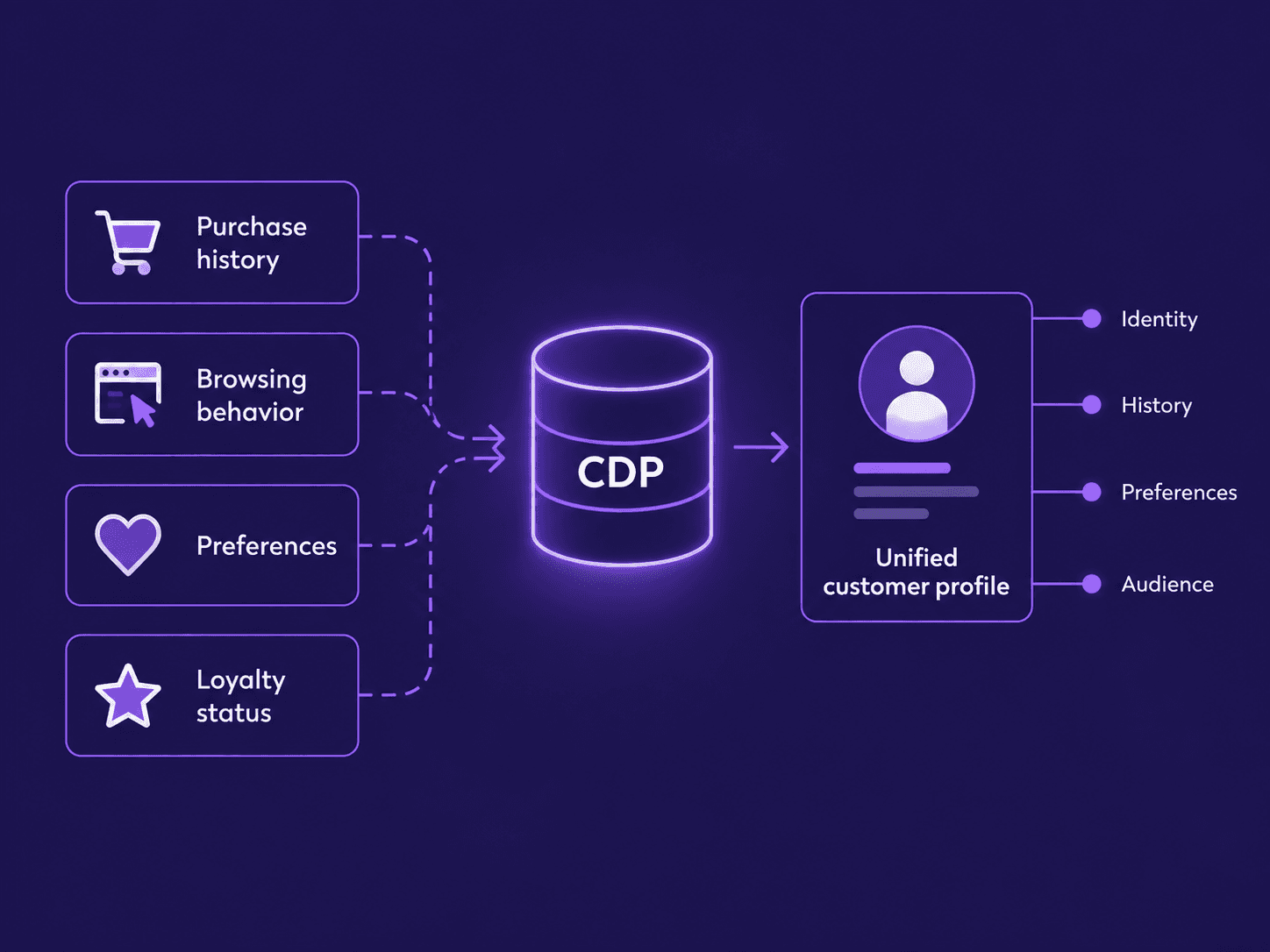
A Customer Data Platform provides the foundation for personalization. Platforms such as Adobe Real-Time CDP can unify customer information from multiple sources to create a more complete customer profile. This gives the business a more complete picture of the customer. But customer history is only one side of personalization.

Fixed Costs: Feel Liberated from Unexpected GenAI Expenses

The financial implications of implementing Generative AI can be unpredictable. As organizations scale operations using GenAI, hidden expenses related to embedding, inference costs, and token usage fees (key processing that drives AI model operations) can escalate rapidly with growing usage, impacting overall ROI. There’s also the build vs. buy conundrum, with enterprises caught in a vicious cycle of overspending on customized solutions.

SearchAI offers a controlled approach to AI implementation, allowing businesses to better oversee their AI expenditures while auto-scaling operations and performance—at any level. SearchAI’s out-of-the-box GenAI solutions are available through a fixed-cost licensing model, providing budget predictability and eliminating surprises associated with variable pricing structures.

Customer Data Platform (CDP) — A Customer Data Platform provides the foundation for personalization. Platforms such as Adobe Real-Time CDP can unify customer information from multiple sources to create a more complete customer profile. This gives the business a more complete picture of the customer. But customer history is only one side of personalization.

02

02


Search
Search is one of the clearest signals of customer intent. “Laptop” and “Lightweight business laptop under $1,500” are not equivalent requests: the second communicates product type, use case, form factor, and budget. Modern search can interpret those signals and identify the customer’s intent. Add customer context—premium device purchases, frequent work travel, endpoint-security research, and higher-priced products—and the system has two sources of intelligence: what the customer wants and who the customer is. That changes search from simple relevance to personalized relevance.


Search
Search is one of the clearest signals of customer intent. “Laptop” and “Lightweight business laptop under $1,500” are not equivalent requests: the second communicates product type, use case, form factor, and budget. Modern search can interpret those signals and identify the customer’s intent. Add customer context—premium device purchases, frequent work travel, endpoint-security research, and higher-priced products—and the system has two sources of intelligence: what the customer wants and who the customer is. That changes search from simple relevance to personalized relevance.


Protect Your Data: Make Data Impenetrable with Private LLM’s
Data security is paramount to reinforcing trust and value in Enterprise GenAI. Many AI systems necessitate sending sensitive data to external platforms, raising concerns about its potential use for training other models, the risk of confidential information leaks, and the overall security of proprietary information.

SearchAI prioritizes data protection using Private LLMs, ensuring that sensitive data remains within the confines of your organization’s control. This ensures fortified security of data with the flexibility to deploy on-premise or on the cloud - all while ensuring that data is protected in-transit, at-rest, or in-use.

03

03

RAG

Personalization becomes more valuable when AI can access trusted business information. RAG allows AI systems to retrieve product specifications, policies, FAQs, documentation, knowledge bases, pricing, service information, and availability before generating an answer. A generic AI model can give general advice; a RAG-powered system can answer a question such as “Which laptop is best for frequent international travel?” using the organization’s current product information. Add the customer profile and current intent, and the AI understands both what the business knows and what the customer needs.

RAG

Personalization becomes more valuable when AI can access trusted business information. RAG allows AI systems to retrieve product specifications, policies, FAQs, documentation, knowledge bases, pricing, service information, and availability before generating an answer. A generic AI model can give general advice; a RAG-powered system can answer a question such as “Which laptop is best for frequent international travel?” using the organization’s current product information. Add the customer profile and current intent, and the AI understands both what the business knows and what the customer needs.

RAG

Personalization becomes more valuable when AI can access trusted business information. RAG allows AI systems to retrieve product specifications, policies, FAQs, documentation, knowledge bases, pricing, service information, and availability before generating an answer. A generic AI model can give general advice; a RAG-powered system can answer a question such as “Which laptop is best for frequent international travel?” using the organization’s current product information. Add the customer profile and current intent, and the AI understands both what the business knows and what the customer needs.

03

04

Recommendations
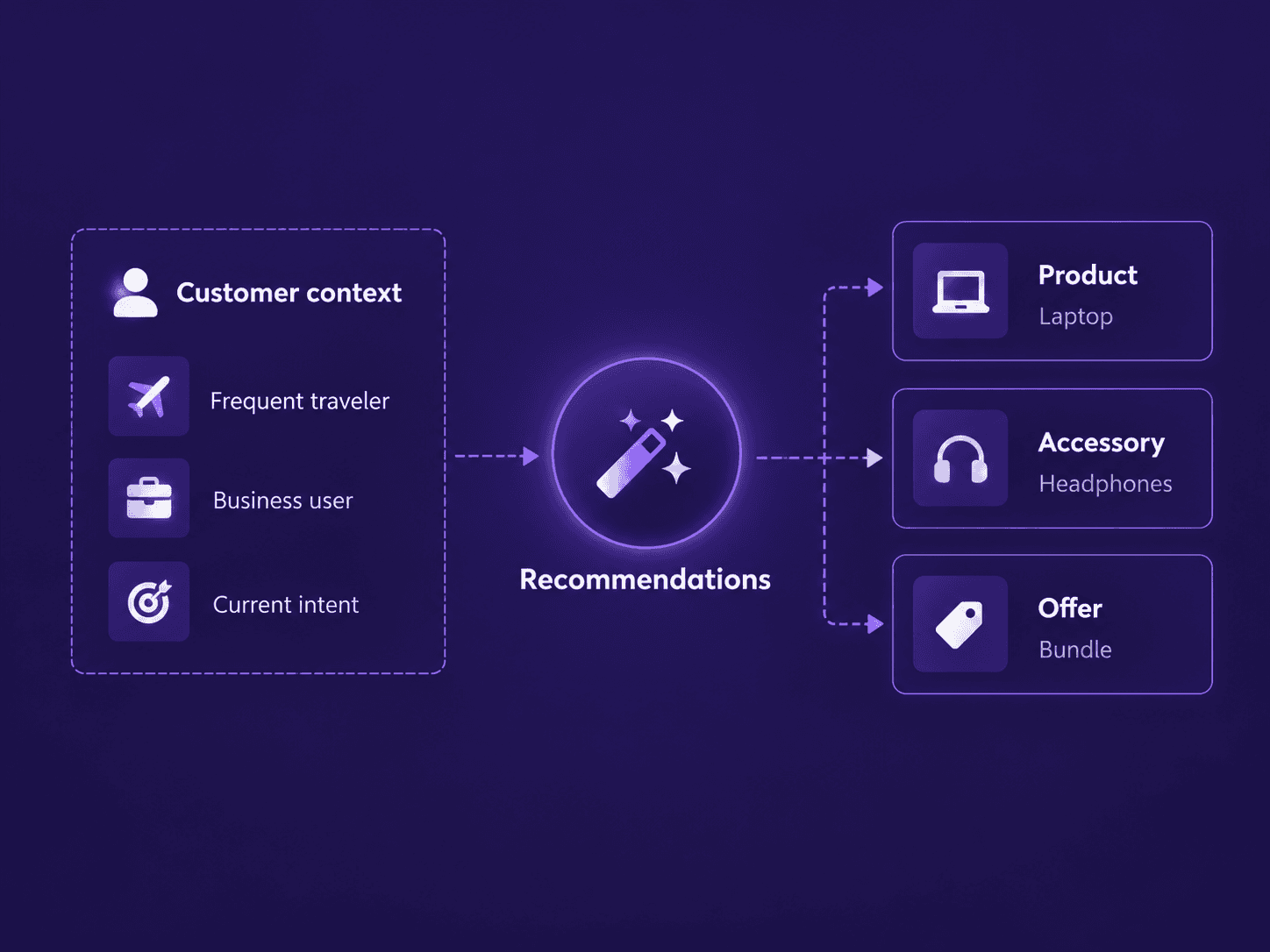
The final layer turns insight into action. Recommendations can determine the next product, accessory, alternative, upgrade, bundle, content, offer, or service to show. They no longer have to rely solely on popularity or past purchases. They can incorporate customer context, current intent, enterprise knowledge, and product relationships. A customer searching for a professional camera can receive compatible lenses, memory cards, bags, or tripods based on their profile and current needs. That is the difference between recommendation and intelligent discovery.

Recommendations
The final layer turns insight into action. Recommendations can determine the next product, accessory, alternative, upgrade, bundle, content, offer, or service to show. They no longer have to rely solely on popularity or past purchases. They can incorporate customer context, current intent, enterprise knowledge, and product relationships. A customer searching for a professional camera can receive compatible lenses, memory cards, bags, or tripods based on their profile and current needs. That is the difference between recommendation and intelligent discovery.


Single Platform: To Simplify all your GenAI Deployments
Typically, enterprises invest in multiple GenAI systems, most of which are standalone systems requiring separate data ingestion pipelines. This results in a siloed environment forcing makeshift integrations that create complexity, reduce efficiency, and increase costs - all while failing to deliver optimal business value.

SearchAI unifies Enterprise Search, RAG, Chatbots, and AI Agents through its Integrated RAG and Hybrid Search Platform. SearchAI eliminates the complexity of managing multiple data feeds and integration points. Organizations can deploy and control all AI capabilities through a single interface, significantly reducing operational overhead while maintaining data accuracy across applications.

04

04

The Value Is in Connecting the Stack

The individual technologies are useful. The real business opportunity comes from connecting them. The flow becomes a continuous personalization loop: every interaction can provide a new signal, improve the customer profile, refine intent, inform retrieval, and influence the next recommendation. Personalization becomes an ongoing process rather than a one-time decision.

Customer journey technology visual

Personalize the Entire Customer Journey

The biggest opportunity is not simply personalizing individual touchpoints. It is personalizing the journey. The customer does not have to start over at every interaction. Context accumulated throughout the journey makes each subsequent interaction more relevant.

Add Context with Knowledge Graphs

Personalization becomes even more powerful when organizations understand relationships between products, content, attributes, and use cases.

A knowledge graph can connect Product → Feature → Use Case → Accessory → Alternative → Upgrade.

The CDP provides context about the customer.

The knowledge graph provides context about the products.

Together, they help the recommendation engine identify what is relevant for this customer and this situation.

Understand Real-Time Intent

Historical data remains valuable, but it cannot be the only source of personalization. A customer whose profile suggests business travel may be repeatedly searching for camping equipment today. A system based only on history may keep recommending travel products. A system combining historical profile with real-time intent recognizes that the current objective has changed. Historical data tells you who the customer is. Real-time intent tells you what they want now. Effective personalization needs both.

The Business Impact

Higher conversion follows from more relevant search and recommendations. Stronger customer loyalty follows from experiences that recognize needs. Better cross-selling comes from understanding product relationships and customer context. Customers spend less time searching, comparing, and navigating irrelevant information. RAG gives AI trusted business knowledge, while customer data gives it the context needed to make that knowledge relevant. Organizations can move beyond manually defined segments toward individualized experiences without creating a separate strategy for every customer.

Personalization Must Be Governed

More personalization means more customer data. That makes governance a strategic requirement. Organizations need clear controls over customer identity, data access, consent, retention, security, AI model access, personalization decisions, and auditability.

The objective is not simply to personalize at scale. It is to personalize responsibly at scale. Private AI architectures can keep sensitive enterprise and customer information within controlled environments, supporting private RAG and AI deployments without requiring organizations to send sensitive enterprise knowledge to external AI providers.

What the New AI Personalization Stack Looks Like

CDP provides customer context. Search captures real-time intent. RAG provides trusted enterprise knowledge. A knowledge graph connects products, content, attributes, and relationships. Recommendations determine what should happen next. AI brings those signals together to create the experience.
The result is a move from “What should we show this customer?”
to
“Given everything we know about this customer and what they need right now, what is the most relevant experience we can provide?”

Turn personalization into the next best action

Turn personalization into the next best action

Build connected experiences that understand intent, surface relevant knowledge, and guide every customer toward what matters next.

Build connected experiences that understand intent, surface relevant knowledge, and guide every customer toward what matters next.

Schedule a Demo

UNDERSTAND

Customer intent

CONNECT

Knowledge signals

GUIDE

Next best action

DELIVER

Relevant outcomes